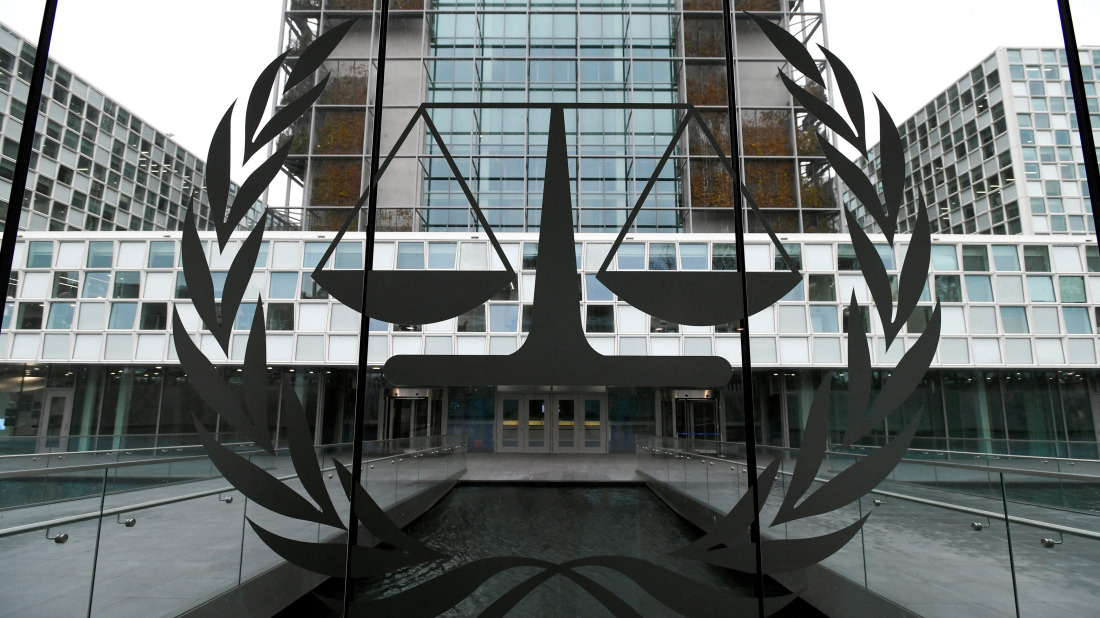
THE HAGUE (Reuters) - The president of the International Criminal Court on Monday said threats facing the institution, including possible U.S. sanctions and Russian warrants for staff members, "jeopardise its very existence".
Speaking at an annual conference of the court's 124 members, President Judge Tomoko Akane did not name Russia or the United States but referred to them as permanent members of the U.N. Security Council.
"It's clear by any metric, by any benchmark, this assembly is at a pivotal time," ICC chief prosecutor Karim Khan said in his speech at the opening of the conference.
"We are facing unprecedented challenges. We see civil society victims, survivors, humanity at large, I think have unprecedented expectations," Khan said.
Russia issued an arrest warrant for Khan two months after the court in The Hague issued a warrant for Russian President Vladimir Putin.
The United States House of Representatives in June passed a bill to sanction the court in response to Khan's request for an arrest warrant against Prime Minister Benjamin Netanyahu and his former defence chief, Yoav Gallant.
"The Court has been subjected to attacks seeking to undermine its legitimacy and ability to administer justice and realise international law and fundamental rights; coercive measures, threats, pressure and acts of sabotage," Akane said, adding that more warrants had been issued against court employees.
The ICC is also "being threatened with draconian economic sanctions from institutions of another permanent member of the Security Council as if it was a terrorist organisation. These measures would rapidly undermine the Court's operations in all situations and cases and jeopardise its very existence," she said.
While the United States is not a member of the court, the world's preeminent military and financial power could undermine the ICC diplomatically and politically and with financial sanctions targeting its staff.
She said the court firmly rejects any "attempt to influence (its) independence and impartiality. We resolutely dismiss efforts to politicise our function. We have and always will comply only with the law, under all circumstances."
The court was established in 2002 to prosecute war crimes, crimes against humanity, genocide and the crime of aggression when member states are unwilling or unable to do so themselves.
'STEP TOWARDS UNRAVELLING'
In its 22 years, the court has not shied away from taking on powerful leaders, including Putin, targeted with an arrest warrant last year over accusations his authorities abducted children from Ukraine, which he and Russia deny. On Wednesday, the prosecutor sought a warrant for Myanmar's military ruler Min Aung Hlaing.
Netanyahu's warrant marks the first time the court has targeted such a figure as the serving leader of a country closely allied to the rich countries of the West.
The ICC, a court of last resort when national authorities are unwilling or unable to act, has no police force. Countries that have signed its founding treaty are on paper required to detain Netanyahu should he arrive on their territory.
But already several European founding members have publicly said they might not do so. France said Netanyahu is immune; Italy said he might be. Britain and Germany have avoided directly explaining how they would act.
Even the Netherlands, which hosts the court in The Hague, has said there could be circumstances in which Netanyahu might be able to visit, without spelling out what those conditions might be.
Selective adherence by members to court orders to detain suspects poses "a very dangerous escalation, a step towards the unravelling of the ICC statute system as a whole," said Sergey Vasiliev, a professor of International Law at the Netherlands Open University and a long-time ICC watcher.
"Now the question is about how serious the state's parties are with respecting the decisions of the court, even in the situation where they do not like the decision," he said.










What is your opinion on this topic?
Leave the first comment