12 Kazakh military personnel die after being washed out to sea during exercises
Twelve Kazakh military personnel died after being swept out to sea during a naval training exercise in the western Mangistau region, authorities sa...
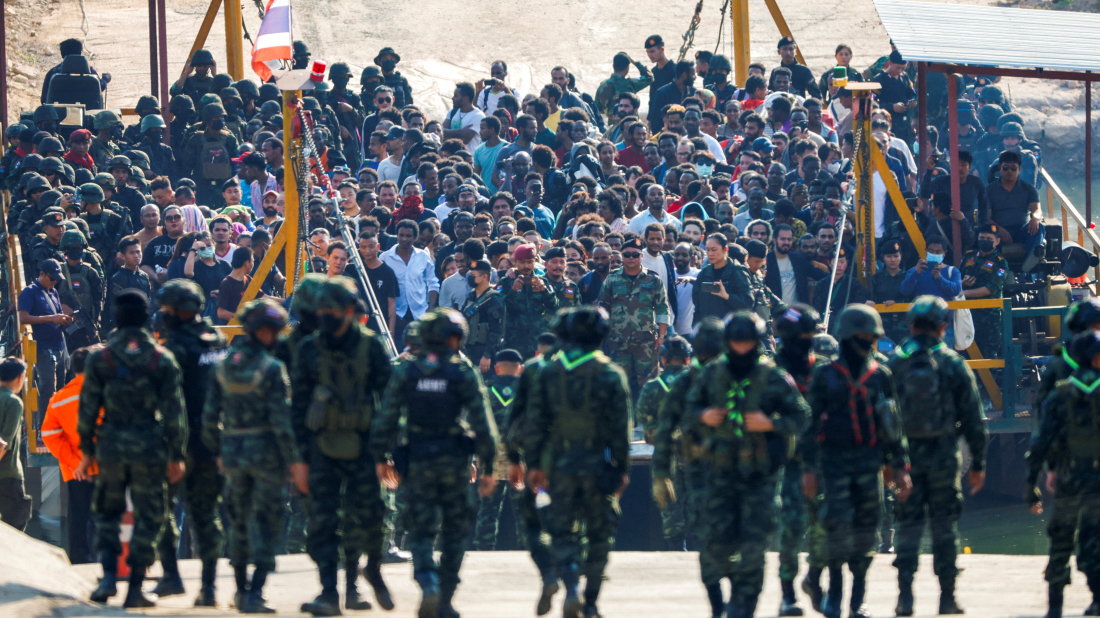
A new UN report has warned that criminal syndicates behind Asia’s billion-dollar cyber scam industry are spreading operations across the globe, reaching as far as South America, Eastern Europe and Africa, as enforcement in Southeast Asia falls short of containing them.
Once concentrated in lawless compounds in Myanmar, Cambodia and Laos, these organised networks now pose a transnational threat, according to the United Nations Office on Drugs and Crime (UNODC). Authorities are struggling to keep pace as the syndicates adapt, migrate and diversify.
“It spreads like a cancer,” said Benedikt Hofmann, UNODC’s acting regional representative. “Authorities treat it in one area, but the roots never disappear; they simply migrate.”
The cyber fraud industry has rapidly outgrown other types of transnational crime. It doesn’t rely on moving illicit goods — only on an internet connection and access to vulnerable victims. Recent years have seen a surge in ‘pig-butchering’ scams, targeting victims through fake online relationships and crypto fraud. In the U.S. alone, such scams caused losses of over $5.6 billion in 2023.
Despite crackdowns on border zones between Thailand and Myanmar — including cutting off electricity and internet — operations have shifted to less monitored regions, including Cambodia’s Koh Kong and parts of Laos and Vietnam. The UN says hundreds of scam “farms” now operate worldwide, generating tens of billions in annual profit.
Governments across Southeast Asia are under pressure. Cambodia’s government has pledged action, forming a commission led by Prime Minister Hun Manet. “To overcome this complex problem, we need collaboration, not blame,” said spokesman Pen Bona.
But while regional efforts grow, so does the industry. Gangs have established footholds in Zambia, Angola, and Georgia, while building money laundering links with South American cartels. Victims and trafficked workers from over 50 countries have been rescued this year alone.

As the Ukraine war is highlighted by some leaders during the United Nations' 81st General Assembly meeting in New York, Russian forces attacked the Ukrainian capital Kyiv early on Thursday with ballistic missiles, killing two people and injuring six, Mayor Vitali Klitschko said.
Shipping traffic through the Strait of Hormuz remained low on Thursday, as Iran reiterated that it will neither enter into new negotiations with the United States nor re-open the Strait as long as its conditions are not met, despite recent indirect talks in New York mediated by Qatar.
U.S. Secretary of State Marco Rubio is set to meet Russian Foreign Minister Sergey Lavrov in New York on Wednesday, as Washington pushes for an end to the war in Ukraine and Kyiv and Moscow continue to strike energy infrastructure.
The 81st UN General Assembly continues in New York on Wednesday, with another day of high-level speeches and diplomatic meetings. The wars in the Middle East and Ukraine, global security and international cooperation remain at the centre of discussions.
The 81st UN General Assembly has wrapped up its third day in New York on Thursday, with world leaders delivering high-level speeches and holding diplomatic meetings.
Here’s your AnewZ Daily Brief for 25 September 2026, with five key developments from the third day of the 81st United Nations General Assembly in New York.
Finland and Sweden deployed fighter aircraft on Thursday after a group of Russian military planes was detected over the Gulf of Finland, the Finnish Air Force reported on Friday (25 September).
Xi Jinping touched down at Joint Base Andrews in Maryland on Wednesday evening to a welcome that was fairly unprecedented. President Donald Trump was there on the tarmac to greet him personally, which is something no sitting U.S. president had done for a visiting foreign leader in six decades.
The U.S. Senate narrowly rejected a resolution on Thursday that would have required President Donald Trump to end the war in Iran or seek congressional authorisation, as Democrats sought to put Republicans on the record over the increasingly unpopular conflict ahead of November's midterm elections.
U.S. President Donald Trump welcomed Chinese President Xi Jinping to the White House on Thursday, 24 September, for talks focused on trade, artificial intelligence, Taiwan and the war with Iran.
You can download the AnewZ application from Play Store and the App Store.
What is your opinion on this topic?
Leave the first comment