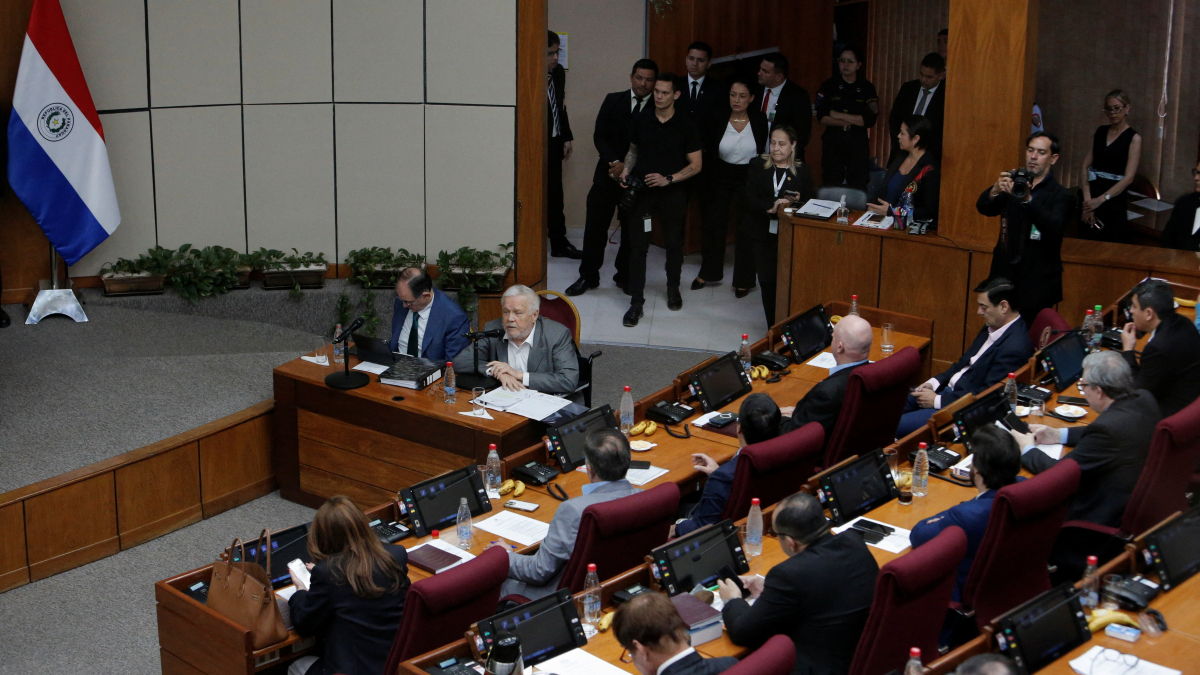
Paraguay's Senate voted on Friday 6 November to remove President Santiago Peña from office after finding him guilty of poor performance of his duties in an impeachment trial over his ties to the collapse of local bank ueno.
The former leader has also been placed under house arrest following the crisis which plunged the country into financial turmoil.
At the end of a two-day process, senators voted 44 to convict Peña, who submitted his resignation on Thursday after losing his party's support.
Vice President Pedro Alliana, a 52-year-old conservative politician, is due to be sworn in to complete the term through 2028.
Although Peña submitted his resignation on Thursday, lawmakers did not accept it which meant that he remained head of state while the impeachment process moved forward.
The decision signalled that legislators wanted a full examination of allegations surrounding the banking scandal rather than allowing the president to leave office without further scrutiny.
The crisis has shaken Paraguay's political establishment and raised concerns about the stability of the country's financial system.
The turmoil began after Paraguay's central bank intervened in Ueno, one of the country's fastest-growing digital financial institutions.
The lender had expanded rapidly, attracting millions of customers, many of whom had never previously held a bank account. Its growth made it a major player in Paraguay's financial inclusion efforts.
However, concerns emerged over the bank's lending practices, governance and connections to influential political and business figures.
Peña himself previously held a stake in the company's parent group, while the governor of the central bank had led Ueno before moving into government.
Following the bank's collapse, the central bank chief resigned and authorities issued arrest warrants for several senior executives as investigators sought to determine what went wrong.
Allegations against the president
Opposition lawmakers accuse Peña of conflicts of interest and of failing to ensure proper regulatory oversight of the institution.
The impeachment motion also alleges misconduct involving pension funds and an alleged effort to shield officials connected to the lender from accountability.
Peña has rejected all allegations, insisting that the bank's failure was a regulatory matter and denying any wrongdoing.
His legal team argues that impeachment proceedings have effectively become unnecessary now that the president has already announced his intention to step down.
Nonetheless, lawmakers appear determined to continue the process, particularly because an impeachment conviction could remove presidential immunity and expose Peña to further legal action.
Prosecutors have already opened criminal investigations linked to the banking scandal.
Public anger grows
The political crisis spilled onto the streets of the capital as hundreds of residents protested in central Asunción, demanding accountability and faster access to money trapped in frozen accounts.
On Friday, demonstrators gathered near the headquarters of the central bank, chanting for the return of their savings.
Among those affected are retirees and pensioners who receive state payments through Ueno and suddenly found themselves unable to access funds.
The government has taken steps to accelerate compensation efforts, and some depositors reportedly began recovering money this week. However, frustration remains high among customers who continue to face uncertainty.
Vice President Pedro Alliana is expected to assume the presidency once the transition process is completed, but he has not yet been sworn into office.
The delay has added to uncertainty surrounding the future leadership of the country.
Financial regulators are simultaneously attempting to reassure investors that the crisis can be contained.
Officials have pledged to protect most deposits and prevent broader contagion across Paraguay's banking sector.
The situation is also being closely watched by neighbouring Brazil, Paraguay's largest trading partner. Regional officials are concerned that a prolonged political confrontation combined with public anger over frozen savings could lead to wider instability.
Meanwhile, senior executives from Ueno have been transferred to a prison facility while awaiting trial, highlighting the growing legal fallout from a scandal that has become one of Paraguay's most serious political crises in recent years.
Read more:









What is your opinion on this topic?
Leave the first comment