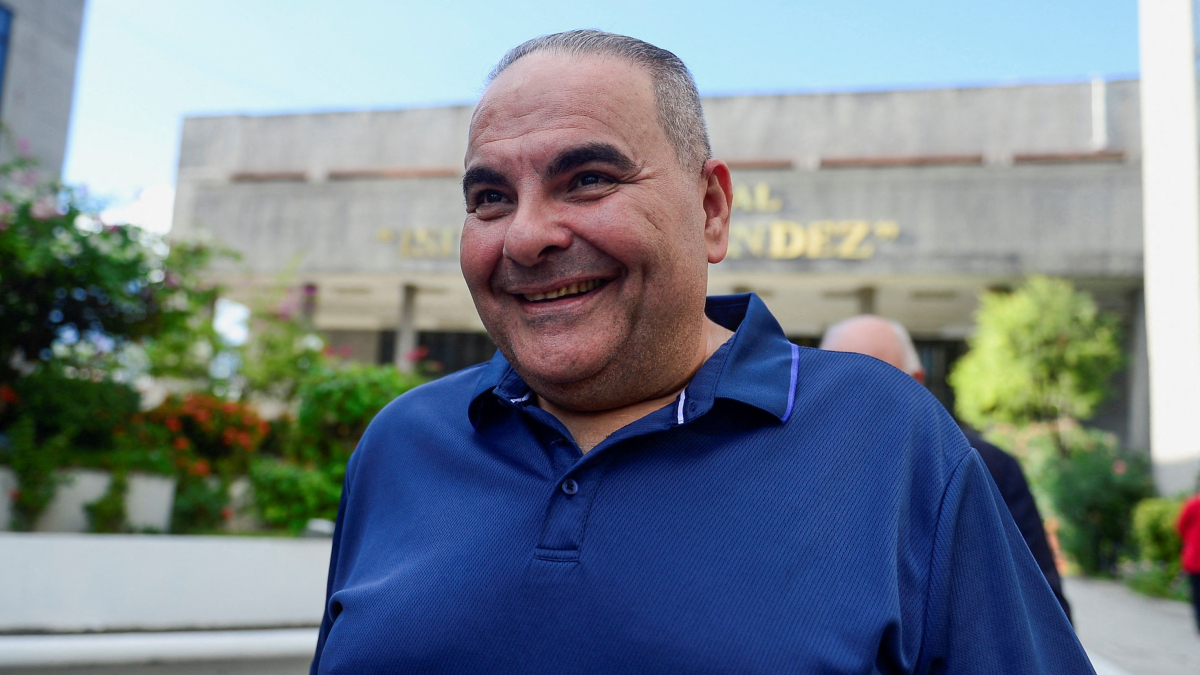
Former Salvadoran president Elias Antonio “Tony” Saca was released from prison on Thursday after completing a reduced sentence for corruption, marking the end of one of the most high-profile political corruption cases in the country's history.
Saca, 61, left court alongside his lawyer, Mario Machado, who confirmed that the former president had fully served the sentence imposed following his conviction for diverting and laundering hundreds of millions of dollars in public funds.
“The 10 years were completed,” Machado told reporters.
“We have come to the court to formally report the release. This was requested just yesterday.”
Saca was convicted in 2018 after admitting to misappropriating and laundering more than $300 million from the Salvadoran state budget during his presidency between 2004 and 2009.
Under a plea agreement reached with prosecutors, Saca accepted responsibility for the crimes in exchange for a reduced sentence. The arrangement lowered a possible 30-year prison term to 10 years.
Although the ruling was handed down in 2018, the sentence was calculated from 2016, when Saca was arrested during his son's wedding, allowing him to complete the prison term this year.
Machado stressed that the former president did not receive early-release benefits and served the sentence in its entirety.
Saca's case was one of several major corruption investigations involving Salvadoran presidents over the past decade.
He is one of four former heads of state to face corruption charges, though he was the only one to serve a substantial prison sentence.
Former president Mauricio Funes left El Salvador for Nicaragua before facing trial, while former president Salvador Sánchez Cerén also relocated there following legal proceedings.
Another former leader, Francisco Flores, died before his corruption trial could begin.
The cases exposed widespread concerns about public sector corruption and the use of state resources by political elites during successive administrations.
Political rise and fall
Before entering politics, Saca built a successful career as a businessman and radio broadcaster.
He was elected president under the banner of the conservative Nationalist Republican Alliance (ARENA), one of El Salvador's dominant political parties for decades.
After later being expelled from ARENA, Saca attempted a political comeback in 2014 as the candidate of the Grand Alliance for National Unity (GANA).
However, the country's Supreme Court ruled that his candidacy violated constitutional provisions, preventing him from seeking another presidential term.
Millions still owed to the state
Prosecutors alleged that Saca used a sophisticated network to redirect state funds for personal benefit and to support political allies, including by channelling large sums of public money to his party.
Beyond the criminal case, civil courts also ordered Saca to repay millions of dollars to the Salvadoran state.
The release does not alter those financial obligations, which remain separate from the completed criminal sentence.
Symbol of anti-corruption efforts
Saca's imprisonment was widely viewed as a landmark moment in El Salvador's efforts to confront high-level corruption.
The conviction demonstrated a willingness by authorities to pursue cases against former senior officials, although critics have argued that accountability remains uneven and politically sensitive.
With his release, one of the country's most prominent corruption prosecutions formally enters a new chapter, though the legacy of the case continues to influence public debates about governance, transparency and political accountability in El Salvador.
Read more:













What is your opinion on this topic?
Leave the first comment