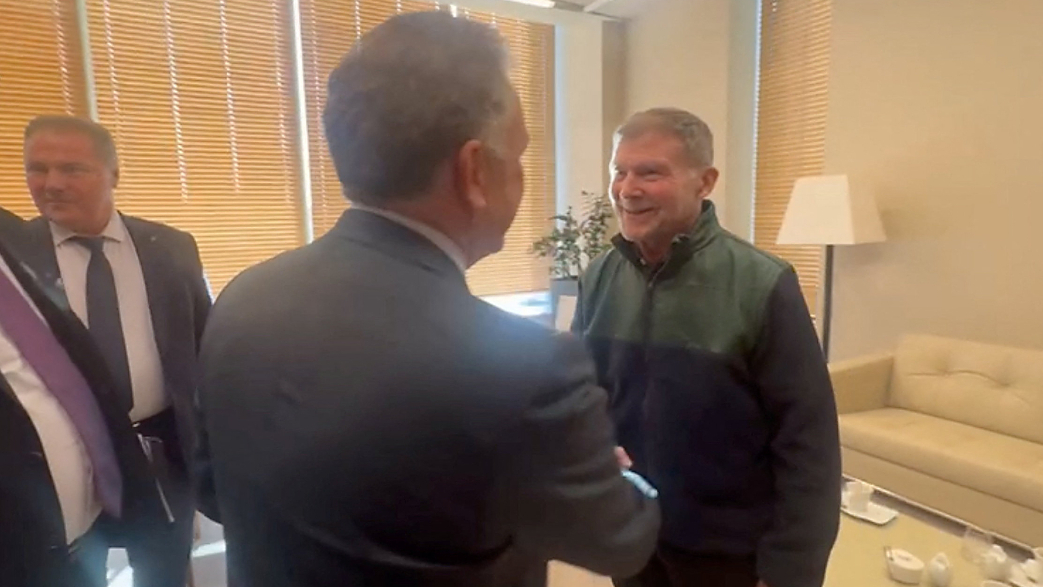
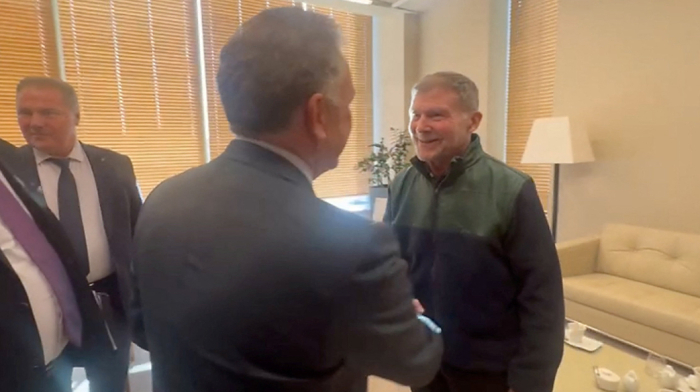
Russia has released Stephen Hubbard, a 74-year-old retired American teacher from Michigan held for more than four years after being detained by Russian forces in eastern Ukraine.
His release comes as Washington intensifies efforts to negotiate an end to the war in Ukraine. But who is Hubbard, why was he imprisoned, and what could his release mean for U.S.-Russia relations?
What happened?
Russian President Vladimir Putin announced Hubbard’s release on Wednesday during a meeting with U.S. special envoy Steve Witkoff in St Petersburg. Putin said Hubbard had already been transferred to the city's Pulkovo Airport.
U.S. President Donald Trump confirmed the release on social media, saying he had personally requested Hubbard’s freedom during a phone call with Putin the previous week.
Witkoff thanked Putin at the meeting, saying Hubbard was on his way home and would soon be reunited with his family.
Who is Stephen Hubbard?
Before his detention, Hubbard had spent much of his adult life overseas. According to military records cited by The New York Times, he grew up in Big Rapids, Michigan, and served in the U.S. Air Force and National Guard.
His sister, Patricia Hubbard Fox, said he had earned a master’s degree in English before spending 25 years teaching in Japan.
Hubbard later moved to Cyprus before settling in Izium, eastern Ukraine, in 2014 with his Ukrainian partner.
Fox told Reuters in 2024 that he survived on a pension of about $300 a month and had few ties to local residents.
How was he captured?
Russian forces seized control of Izium roughly two months after launching their full-scale invasion of Ukraine in February 2022. Although Ukrainian forces recaptured the city that September, Hubbard remained in Russian custody.
Russian state media claimed he had been detained in April 2022 while manning a Ukrainian military checkpoint. Reuters could not independently verify the circumstances of his capture.
His sister said she recognised him in videos posted online, including footage appearing to show him with his hands bound as someone struck him with a sandal. Reuters was unable to verify when or where the footage was filmed.
Why was he imprisoned?
In October 2024, a Moscow court convicted Hubbard of acting as a mercenary following a closed-door trial, sentencing him to six years and 10 months in prison.
Prosecutors alleged he had joined a Ukrainian territorial defence unit, undergone military training, received weapons and ammunition, and been promised $1,000 a month.
Russian state media claimed he pleaded guilty, making him the first American known to have been convicted of fighting for Ukraine since Russia's full-scale invasion.
However, his family and lawyer have strongly disputed the allegations. Fox questioned the reported confession, saying her brother held pro-Russian views and was unlikely to have taken up arms in his seventies.
His U.S.-based lawyer, Martin De Luca, said in June 2025 that Hubbard denied ever belonging to a military or combat unit and maintained that Russian soldiers had seized him from his home.
Why did the U.S. consider him wrongfully detained?
Washington formally designated Hubbard as wrongfully detained in January 2025, enabling U.S. authorities to pursue negotiations for his release.
The State Department said Russia had denied American officials consular access to Hubbard throughout his detention.
Finding out where he was being held also proved difficult. The New York Times reported that he had been transferred between at least five Russian detention centres before his trial.
His lawyer said the legal team only discovered in April 2025 that he was being held in Mordovia, east of Moscow.
NBC News reported that Hubbard was the last American held in Russia to have been formally designated as wrongfully detained.
Why does his release matter?
Unlike several previous high-profile releases, Hubbard's freedom was not secured through a prisoner exchange.
Trump said Washington had offered nothing in return, describing the arrangement as unprecedented.
However, the release comes against a backdrop of broader diplomatic developments. The Kyiv Independent noted that Trump had waived sanctions on Russia the previous week and agreed earlier in the month to purchase Russian diesel.
NBC News characterised Hubbard's release as another indication of improving ties between Washington and Moscow, as the U.S. pushes Ukraine towards a negotiated settlement.
Witkoff travelled to St Petersburg in an effort to revive stalled peace negotiations, with the aim of arranging a three-way meeting involving Putin, Trump and Ukrainian President Volodymyr Zelenskyy.
However, according to The Kyiv Independent, Russian state media had made no mention of Putin agreeing to participate in such talks.
The case also highlights longstanding concerns about Russia's detention of foreign nationals. Analysts and human rights advocates have repeatedly accused Moscow of using foreign detainees as bargaining chips in diplomatic negotiations.
Former Russian President Dmitry Medvedev appeared to reference the practice in a 9 October Telegram post, suggesting Russia might need to add Europeans and Americans to its “exchange fund”.
Which Americans remain in Russian custody?
Hubbard is the second American to be released from Russian detention in roughly two months.
U.S. Marine veteran Robert Gilman, who was seriously ill and imprisoned on disputed charges of assaulting a police officer, was freed in August.
Several other Americans remain behind bars in Russia, including some with serious medical conditions.
Global Reach, an organisation representing five Americans detained in Russia, welcomed Hubbard’s release.
However, its chief strategy officer, Eric Lebson, said the families of those still imprisoned would struggle to understand why their loved ones had been excluded from the arrangement.
What happens next?
Hubbard is expected to return to the U.S., where he is likely to undergo medical assessments following more than four years in Russian custody.
His release now raises two pressing questions: whether the diplomatic gesture will help revive efforts to end the war in Ukraine, and whether other Americans detained in Russia could soon regain their freedom.
Read more:









What is your opinion on this topic?
Leave the first comment