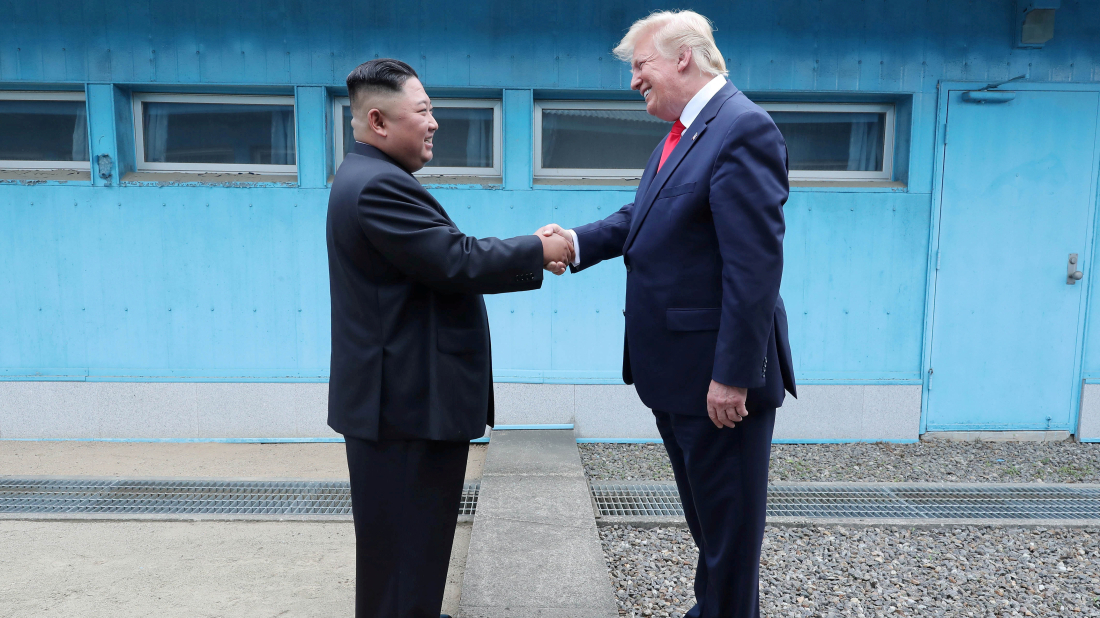
U.S. President Donald Trump has extended multiple invitations to meet North Korean leader Kim Jong Un ahead of his visit to South Korea this week, with Seoul officials publicly supporting the idea.
So far, Pyongyang has remained silent, and U.S. and South Korean officials have said that no concrete plans for a meeting are in place. Before Trump’s departure from Washington, North Korea conducted a test launch of what it described as a new hypersonic ballistic missile.
Trump has used his tour of Asia to highlight his willingness to meet Kim, aiming to revive the series of summits the two leaders held during his first term.
“I had a good relationship with him,” Trump told reporters on Monday. “I’d love to see him if he wants to — if he even gets this message. We haven’t mentioned anything, but he knows I’m going there. If he’d like to meet, I’d be happy to.”
When asked what leverage he could use to bring Kim back to negotiations, Trump pointed to sanctions. “That’s pretty big to start off with,” he said. “I’d say that’s about as strong as you can get.”
The pair previously held summits in 2018 and 2019 before talks collapsed over Pyongyang’s nuclear weapons programme. North Korea remains under strict international sanctions due to its nuclear and ballistic missile development.
Last month, Kim signalled a potential willingness to meet Trump if the United States abandoned its demands for denuclearisation, while ruling out dialogue with South Korea. “Personally, I still have fond memories of U.S. President Trump,” Kim said in a speech carried by the Korean Central News Agency. “If the U.S. drops its absurd obsession with denuclearising us and accepts reality, seeking genuine peaceful coexistence, there would be no reason not to sit down with them.”
However, there is no indication that such a meeting will take place. A U.S. official confirmed that a visit to the Demilitarised Zone between North and South Korea had been considered but not scheduled.
South Korean President Lee Jae Myung, who took office in June and has aimed to reduce tensions with Pyongyang, has suggested that Trump could use his visit to open a new dialogue.
Unification Minister Chung Dong-young said North Korea might respond to Trump’s proposal by Tuesday or Wednesday, while Foreign Minister Cho Hyun told parliament that Trump’s reference to North Korea as a “nuclear power” and hints at easing sanctions could encourage Kim to engage.
“However, compared to 2017 and 2018, North Korea has now formed a military alliance with Russia and deepened its ties with China,” Cho added.
On Monday, North Korea’s foreign minister met with Russian President Vladimir Putin. The two countries signed a strategic partnership last year, including a mutual defence pact, and Pyongyang has reportedly sent troops, artillery, ammunition, and missiles to support Moscow’s campaign in Ukraine.
In Tokyo on Tuesday, Trump met with the families of Japanese citizens abducted by North Korea decades ago.

















What is your opinion on this topic?
Leave the first comment