Residents in an eastern Taiwan town where flooding from a strong typhoon killed 15 people took to shelters on Wednesday fearing further disaster, as Premier Cho Jung-tai called for an inquiry into what went wrong with evacuation orders.
Sub-tropical Taiwan, frequently hit by typhoons, normally has a well-oiled disaster mechanism that averts mass casualties by moving people out of potential danger zones quickly.
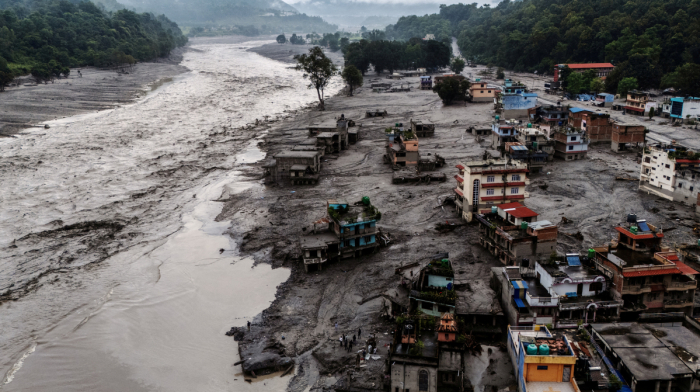
But many residents in Guangfu, an inundated town in the beauty spot of Hualien thronged by tourists, said there was insufficient warning when the lake overflowed during Tuesday's torrential rains brought by Super Typhoon Ragasa.
Originally the number of missing was thought to be 152 but the fire department has adjusted that figure down to 17 and said one other person had been confirmed dead, bringing the death toll up to 15.
Earlier, Cho said the immediate priority was to find those still missing but that questions remained.
"For the 14 who have tragically passed away, we must investigate why evacuation orders were not carried out in the designated areas," he told reporters in Guangfu.
"This is not about assigning blame, but about uncovering the truth."
The barrier lake, formed by landslides triggered by earlier heavy rain in the island's sparsely populated east, burst its banks to send a wall of water into Guangfu.
As heavy rain continued on and off in Hualien, police cars sounded sirens for a new flood warning in Guangfu on Wednesday, sending people scrambling for safer areas as residents and rescuers shouted, "The flood waters are coming, run fast."
"We will not return until the overflow is finished or the risk of it bursting is reduced. It's too dangerous," said a woman who gave her family name as Tsai from a packed emergency shelter in an elementary school.
Deputy disaster command centre chief Huang Chao-chin said with rainfall easing and much of the water from the lake already released, he did not expect a repeat of Tuesday's mass flooding.
Lamen Panay, a Hualien councillor, said the Democratic Progressive Party (DPP) government evacuation requests before the flood had not been mandatory.
Referring to guidance for people to head to higher floors, she said, "What we were facing wasn't something 'vertical evacuation' could resolve."
Taiwan has been lashed since Monday by the outer rim of Typhoon Ragasa, which was downgraded from a super typhoon and is now hitting China's southern coast and the Asian financial hub of Hong Kong.
Like a 'Tsunami'
The water hit like a "tsunami", said Guangfu postman Hsieh Chien-tung, who was able to flee to the second floor of the post office just in time. Later, he got home to find his car had been swept into the living-room.
Fire officials said all the dead and missing were in Guangfu, where the waters destroyed a major road bridge across a river.
Regions across Taiwan have dispatched rescue teams to Hualien, with the military sending 340 troops to help.
In Guangfu, soldiers operating from an armoured personnel carrier to keep clear of thick mud in the streets went door-to-door handing out water and instant noodles. Wrecked cars and scooters were littered around.
About 5,200 people, or 60% of the population, sought shelter on the higher floors of their own homes while most of the rest left to stay with families, government data showed.
Enough water to fill 36,000 Olympic-sized swimming pools
The government said the overflow of the barrier lake released about 60 million tonnes of an estimated 91 million tonnes of water, enough to fill about 36,000 Olympic-sized swimming pools.
Besides the wilderness beauty that makes it one of Taiwan's top tourist draws, Hualien is also home to many members of the island's indigenous groups, including the Amis.
The typhoon brought about 70 cm (28 inches) of rain to Taiwan's east, though the populous west coast, home to the crucial semiconductor industry, was not affected.
In 2009, Typhoon Morakot brought destruction to Taiwan's south, killing about 700 and causing damage of up to $3 billion.














What is your opinion on this topic?
Leave the first comment