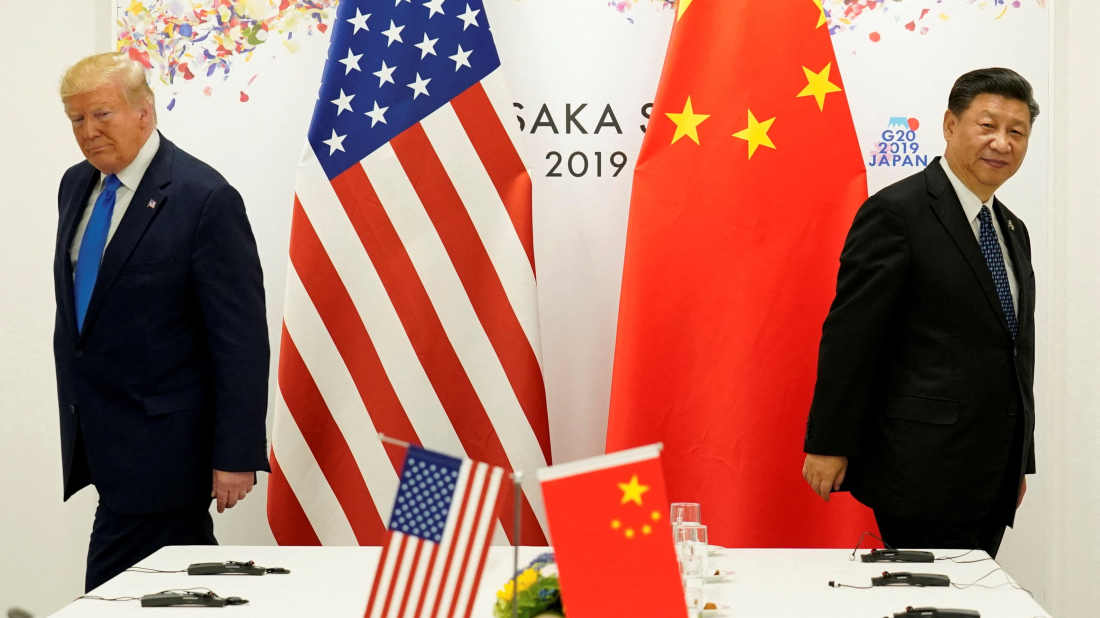
Global investors remained wary on Friday after a closely watched phone call between U.S. President Donald Trump and Chinese President Xi Jinping failed to deliver concrete progress on trade. Chinese markets reflected the cautious sentiment, with modest declines across key indices.
The Shanghai Composite Index ended flat, the CSI300 edged down 0.1%, and Hong Kong’s Hang Seng Index dropped 0.4%, signaling that markets had anticipated little from the rare leader-to-leader exchange.
Despite the high-profile nature of the call, analysts noted that it offered few specifics, particularly on tariff reductions or technology access — two of the most contentious points in the current trade standoff. The 90-day tariff rollback deal, agreed in May, remains fragile amid ongoing disputes over critical minerals, chip export controls, and Taiwan.
“There’s nothing concrete that’s positive,” said Guo Jianwen of Haiyi Capital. “So little impact on stocks — only some trading opportunities.”
Gary Ng of Natixis echoed the sentiment, saying the call gave “no certainty” on the scope or substance of any future trade agreement. “It may only be a partial one given the wide range of issues,” he noted.
William Xin of Pu Jiang Investment Management pointed out that the only clear relief was that “things are not getting worse.” He added that a Trump visit to China could be a potential turning point for market sentiment.
Others viewed the call’s diplomatic tone as a temporary calming signal. Charles Wang of Shenzhen Dragon Pacific Capital Management noted Xi's warning to Trump against provocative moves on Taiwan, interpreting it as a sign China is not imminently planning to escalate tensions over the island.
Still, skepticism prevailed. “Trump’s fickleness has made such talks less and less meaningful to the market,” said Wang Zhuo of Zhuozhu Investment.
On a more optimistic note, Gao Le of Galaxy Securities in Beijing said the recent appreciation of the yuan reflects confidence in China’s economic resilience. “Market sentiment will continue to heal,” he said, pointing to U.S.-listed Chinese stocks rising even as broader U.S. markets dipped.
Charu Chanana of Saxo in Singapore summarized the mood: “Markets are relieved the Trump-Xi call didn’t escalate tensions further — but that’s not quite a reason to cheer either.” With core issues unresolved, she warned, “new flashpoints can emerge at any time.”
For now, investors appear to be shifting focus to upcoming economic indicators, particularly the U.S. jobs report due later Friday, while keeping a close eye on any further signals from Beijing or Washington.

















What is your opinion on this topic?
Leave the first comment