China has successfully launched a new set of low Earth orbit satellites, continuing its ongoing space deployment efforts, according to state media.
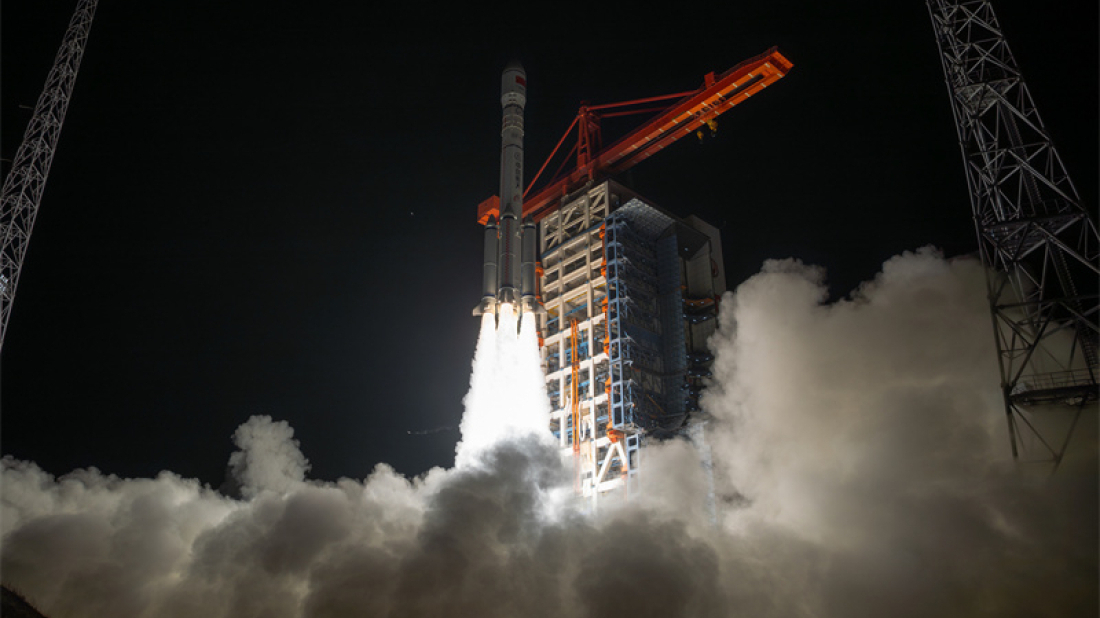
China successfully launched a new group of low Earth orbit (LEO) satellites from the Taiyuan Satellite Launch Centre in north China's Shanxi Province early Friday morning. This launch contributes to the nation's ongoing development of a space-based internet constellation.
The satellites, which constitute the fourth group of their kind intended for this constellation, lifted off at 4:45 a.m. Beijing Time aboard a modified Long March-6 carrier rocket. The satellites successfully entered their preset orbit. This mission marks the 580th launch for the Long March series of carrier rockets, demonstrating the continued operational cadence of China's launch capabilities.
China is actively developing several large-scale satellite internet constellations in low Earth orbit. These projects aim to provide global broadband internet services and are often compared to initiatives like SpaceX's Starlink and Amazon's Project Kuiper. One key effort is Guowang (National Network), a state-backed project established in 2021 that aims to deploy nearly 13,000 satellites. Its goal is to establish a national broadband network from space, ensuring connectivity. Another significant project is Qianfan (Thousand Sails) / SpaceSail, backed by the Shanghai Municipal People's Government, which plans to deploy over 15,000 satellites by 2030 to provide low-latency, high-speed, and ultra-reliable satellite broadband internet services, with initial phases focusing on regional coverage before expanding globally. The "G60 Starlink" is also associated with this initiative.
Beyond these, the Tianqi Constellation, developed by GuoDianGaoKe Technology, has already reached its first phase with 37 satellites in orbit, forming a global network for IoT (Internet of Things) connectivity, smart cities, and emergency communications. The project aims to expand into consumer markets, including smartphones and smart vehicles. Furthermore, Geely's Future Mobility Constellation, developed by commercial space subsidiary Geespace, is designed to revolutionise intelligent connectivity for road vehicles and consumer electronics. It has a three-phase plan, with a long-term goal of 5,676 satellites for global broadband services and direct smartphone connectivity. These various constellations highlight China's multi-pronged approach to establishing a comprehensive space-based communication infrastructure. The development of these networks is seen as strategically important for both commercial and potential military applications, and for securing orbital and frequency resources in an increasingly competitive space environment.
The modified Long March-6 is part of China's new generation of liquid-fueled carrier rockets. It is designed to be a small-to-medium-lift launch vehicle, capable of placing payloads into various orbits, including low Earth orbit and sun-synchronous orbit. The Long March-6 family, including variants like the Long March-6A and Long March-6C, utilises environmentally friendly propellants such as kerosene and liquid oxygen. These rockets are known for their efficiency and adaptability, making them suitable for the frequent deployment of satellites for constellations and other missions. The Long March-6 series has played a significant role in China's commercial launch services.





















What is your opinion on this topic?
Leave the first comment