Why Tashkent's summer storms are becoming more intense
Unusually heavy rain, thunderstorms and hail during Uzbekistan's hottest season have sparked widespread debate over the causes. While some blame clima...
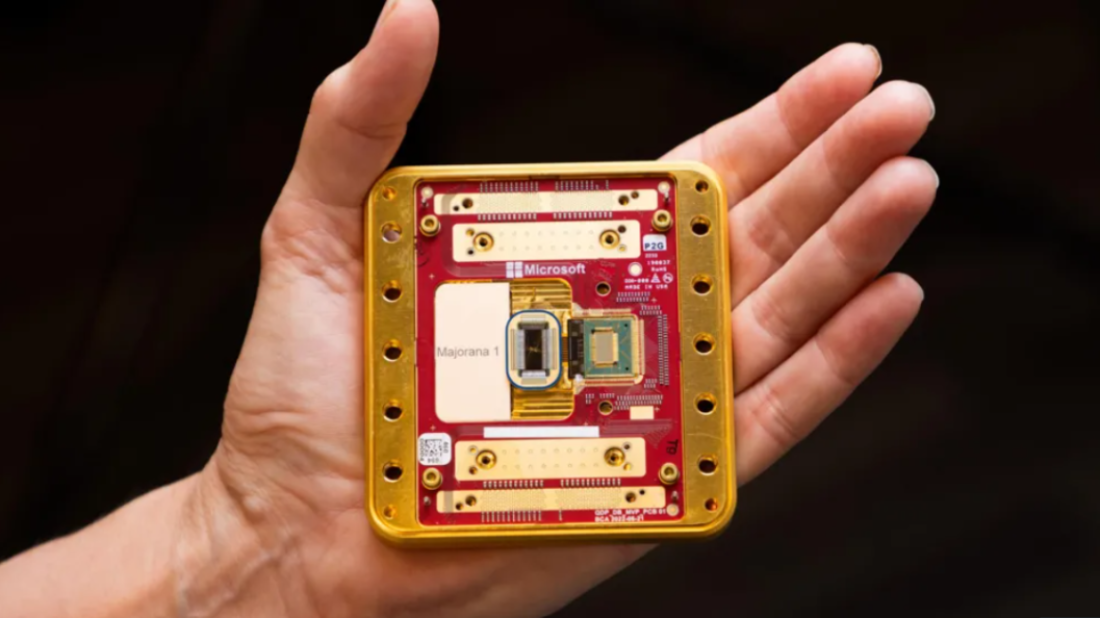
Microsoft has announced a breakthrough in quantum computing with its new Majorana 1 chip, claiming it could enable computers to solve complex, real-world problems within years rather than decades.
Microsoft unveiled its latest quantum computing innovation on Wednesday, introducing a new type of chip that it says will accelerate the path to practical quantum machines. The Majorana 1 chip is built using a "topological conductor", a material designed to create a new quantum state that improves stability and scalability.
The company describes this breakthrough as transformative, comparing it to the impact semiconductors had on modern computing. It claims that by overcoming key challenges, the new chip could significantly shorten the timeline for useful quantum computing.
📌 The Quantum Race:
Tech firms worldwide are investing billions in developing quantum computers, aiming to build machines that can solve problems classical computers cannot. Quantum technology holds the potential for breakthroughs in medicine, chemistry, and energy storage.
🔬 How Microsoft’s Approach Differs:
Unlike many rivals, Microsoft has focused on Majorana particles, which were once purely theoretical. The company says its topoconductor material allows for more stable qubits—the fundamental building blocks of quantum computing.
Paul Stevenson, Surrey University: Calls it a “significant step” but warns major hurdles remain.
Chris Heunen, University of Edinburgh: Says Microsoft’s roadmap is “credible” but the next few years will test its success.
Travis Humble, Quantum Science Center: Acknowledges faster prototype development but says scaling up remains a challenge.
Microsoft has placed eight topological qubits on the new chip—fewer than competitors like Google, which recently introduced its Willow quantum processor. However, the company claims it has a clear path to scaling up to a million qubits, which could revolutionize computing power.
While quantum computing is still far from mainstream use, Microsoft’s latest breakthrough signals a high-risk, high-reward bet on what could be the next major leap in technology.

The death toll from Venezuela's devastating twin earthquakes has risen to 3,342, according to the country's information ministry, as rescue teams continue searching affected areas and survivors face an uncertain recovery.
Russia's Defence Ministry has said its forces are clearing the town of Lyman in Donetsk of Ukrainian forces, Moscow's state news agency Tass reported. Meanwhile, Russian attacks killed at least six people across three Ukrainian regions on Friday, regional officials said.
Governments are tightening restrictions on teenagers’ use of social media amid growing concerns over mental health, online safety and platform design, but questions remain over enforcement and whether bans can meaningfully change behaviour.
President Donald Trump said Iran is keen to reach a deal with the United States, claiming Washington had paused engagement to allow funeral ceremonies for late Iranian Supreme Leader Ali Khamenei.
Mexico's national football team has returned luxury Rolex watches gifted by American content creator Stevewilldoit after concerns that they could conflict with FIFA's ethics rules.
Humanoid robots stumbled, collided and recovered as they battled for the RoboCup 2026 football title on Sunday (5 July), showcasing the latest advances in robotics and artificial intelligence at the world's largest competition of its kind.
India is investigating a data breach at Tata Electronics that exposed sensitive documents linked to Apple's unreleased iPhone 18 Pro, marking the government's first public comments on the incident.
Humanity’s return to the Moon is about far more than planting flags and collecting samples. Under NASA’s Artemis programme, the goal is to establish a lasting human presence, with lunar rovers set to play a vital role in making that vision possible.
American technology company Snap has launched its first augmented-reality (AR) glasses for consumers, marking a major push into wearable computing as tech firms race to redefine personal devices in the AI era.
The Canadian government has introduced a digital safety bill that would ban children under the age of 16 from using social media, unless platforms meet specific safety standards.
You can download the AnewZ application from Play Store and the App Store.
What is your opinion on this topic?
Leave the first comment