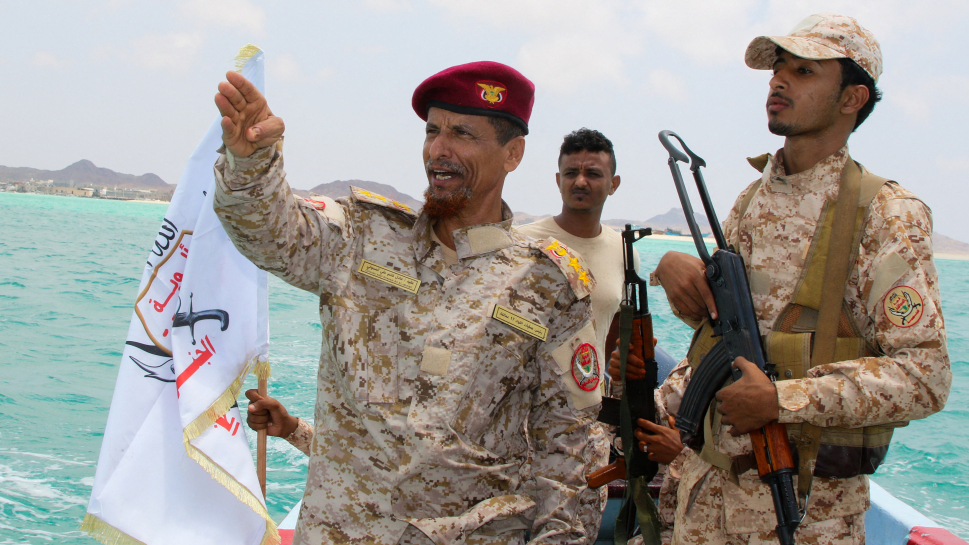
Forces aligned with Yemen's internationally recognised government have recaptured significant stretches of the Red Sea coast near the Bab el-Mandeb Strait, marking one of their most important advances since fighting resumed earlier this year and dealing a setback to the Iran-backed Houthis.
Backed by intensive Saudi air support, government troops pushed north along the coastline and entered the outskirts of the port city of Mocha on Monday.
Yemen's Defence Ministry later announced that the city had fallen under government control, while military sources said Houthi fighters were withdrawing towards nearby highland areas.
The offensive also enabled government forces to regain control of several strategic positions, including an airstrip in the Dhubab district near the entrance to the Bab el-Mandeb Strait, one of the world's most important maritime chokepoints.
The latest fighting centres on the Bab el-Mandeb Strait, a narrow passage connecting the Red Sea to the Gulf of Aden and the Indian Ocean. The waterway is a vital route for global energy supplies and commercial shipping.
The Houthis' seizure of coastal territory around the strait last month rattled energy markets and raised concerns about the security of shipping lanes already under pressure from wider regional instability.
Although the government's latest gains would complicate Houthi efforts to control maritime traffic through the corridor, security experts note that the group would still be capable of targeting vessels from positions further inland and along other parts of Yemen's coast using drones and missiles.
The Houthis dismissed the government's claims, describing reports of major territorial losses as inaccurate.
Reuters was unable to independently verify battlefield developments reported by either side.
Houthis advance on another front
Despite losing ground along the Red Sea coast, the Houthis appeared to achieve gains elsewhere.
Military sources affiliated with the government said Houthi fighters advanced near the southwestern city of Taiz, capturing sections of a mountain road that links the city with areas controlled by government forces.
Several sources said the advances had increased pressure on Taiz, Yemen's third-largest city, potentially leaving government troops stationed there increasingly isolated. One government official, however, disputed reports that the key route had been completely cut off.
The Houthis have also threatened to expand attacks into Saudi airspace as fighting intensifies.
The renewed conflict has drawn a stronger response from Saudi Arabia, which said it had launched extensive air operations in support of government forces.
Saudi officials said hundreds of targets had been struck to provide cover for operations around the Bab el-Mandeb Strait and support advances by Yemeni ground forces.
Yemen's internationally recognised government also reported military operations on several fronts, including in areas around Sanaa.
Meanwhile, the Houthi-run health ministry said Saudi-led strikes in Sanhan and Sa'wan districts had killed two people and wounded seven others.
President Rashad al-Alimi vowed that government forces would continue fighting until the country was “liberated” from Houthi control.
Regional powers activate defence pact
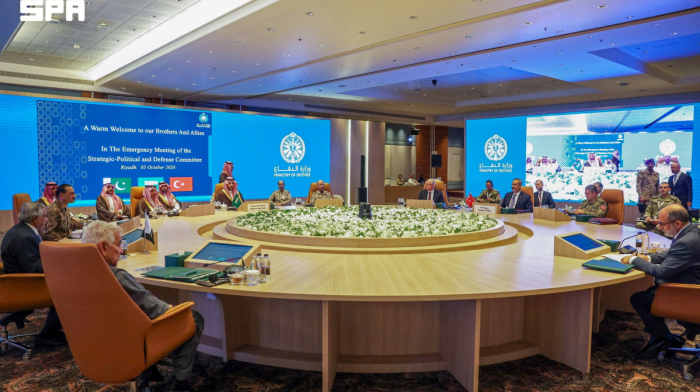
The escalation prompted an emergency meeting in Riyadh between Saudi Arabia, Türkiye and Pakistan under the recently signed Mecca Joint Defence Agreement.
Following the meeting, the three countries announced plans to rapidly deploy agreed military forces and capabilities to Saudi Arabia under the pact.
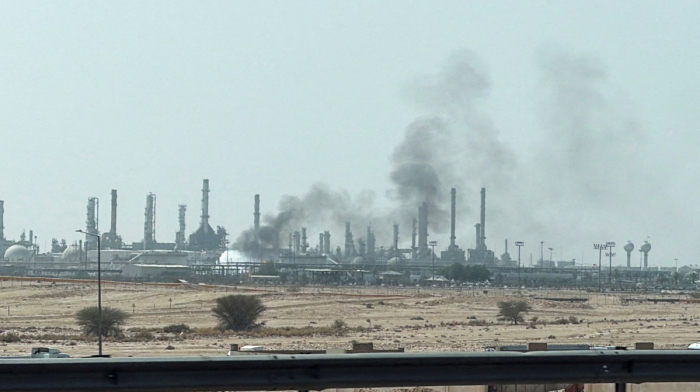
In a joint statement, the three governments condemned what they described as Houthi attacks targeting Saudi cities, economic facilities and critical infrastructure. The statement also accused the group of threatening Islam's holiest sites, Mecca and Medina.
The defence agreement, signed in August, treats an armed attack on any member country as an attack on all three.
Humanitarian toll mounts
The latest military escalation comes after the collapse of a ceasefire that had broadly held since 2022.
The war, which began when the Houthis seized large parts of Yemen and prompted a Saudi-led intervention in 2015, has already created one of the world's worst humanitarian crises.
The renewed fighting has worsened conditions across the country. The United Nations migration agency said 184,000 people have been displaced since hostilities resumed this summer.
In Taiz, where fighting remains intense, residents describe increasingly difficult conditions. Long queues formed outside petrol stations as shortages of fuel and cooking gas worsened amid fears that supply routes could be cut.
The latest developments underscore how Yemen's conflict has become increasingly intertwined with wider regional tensions, including the confrontation between Iran and the United States and growing concerns over the security of key energy and shipping routes stretching from the Strait of Hormuz to the Bab el-Mandeb.
Read more:
















What is your opinion on this topic?
Leave the first comment