Human body heat excludes most fungi. On Baltimore’s hottest streets and inside laboratory incubators, scientists are testing whether a warming world is shifting that ancient boundary.
“For most fungi, 37°C is a wall. For a rare few, it may become an evolutionary accelerator.”
The candy on the pavement
The experimental equipment was a square of fruit-flavoured taffy.
During summer sampling in Baltimore, researchers pressed the softened taffy into the grooves of a city sidewalk and rolled it across roughly 100 square centimetres for 30 seconds. Dust, fungal spores and fragments of microscopic life adhered to its sticky surface. In the laboratory, the candy was dissolved and the recovered material spread across nutrient plates. Over the following days, colonies appeared: pale yeasts, dark moulds and other fungi that had been living beneath pedestrians’ feet.
The method sounded almost playful. The question behind it was not.
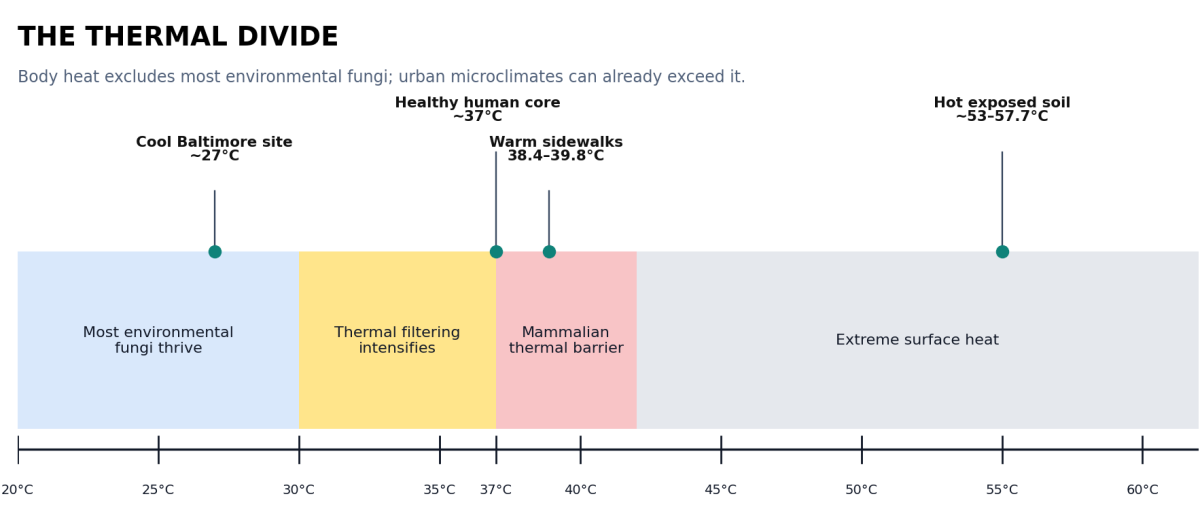
The researchers were collecting fungi from neighbourhoods at opposite ends of Baltimore’s urban heat island. The coolest sampled surfaces were around 27°C. Sidewalks in the warmest locations measured about 38.4–39.8°C; exposed soil at those sites averaged roughly 53–57.7°C and in places approached 60°C. These microenvironments were not merely hotter than the surrounding air. Some exceeded the internal temperature of a healthy human body.
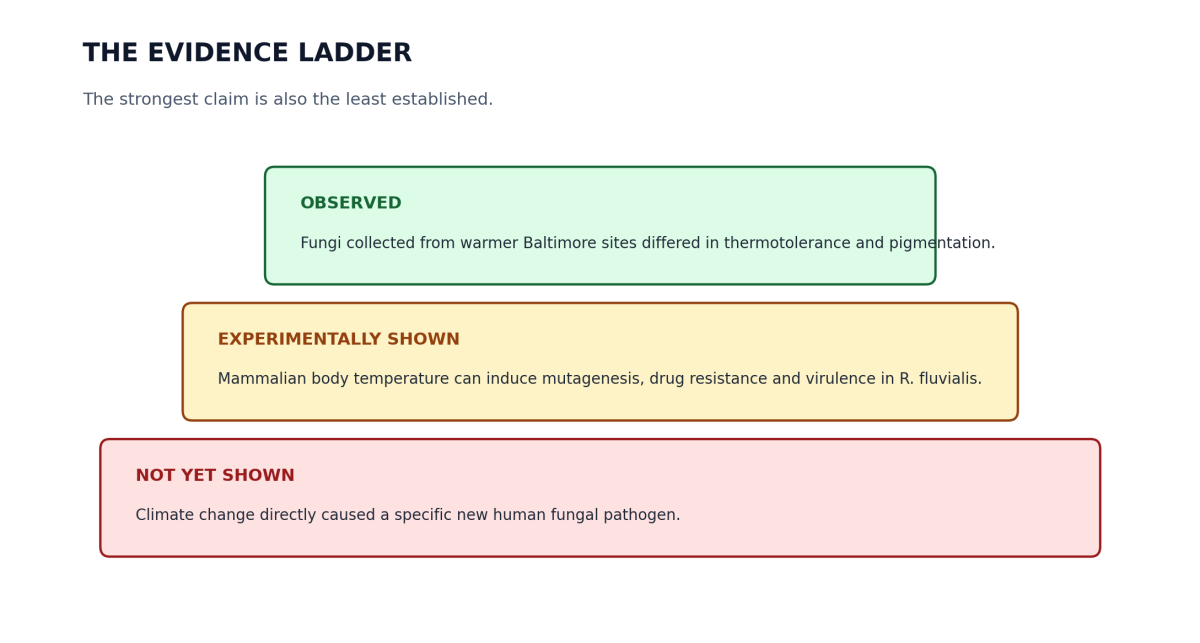
When the isolates were tested, fungi from warmer neighbourhoods showed different thermal characteristics from comparable isolates found in cooler areas. They also tended to be lighter in colour, a pattern consistent with known fungal mechanisms that regulate heat through pigmentation.
One result carried particular weight. A strain of Cystobasidium minutum collected from a 38.4°C sidewalk could grow continuously at 37°C. Another isolate of the same species from the same broad location could not. A strain of Rhodotorula mucilaginosa recovered from a warmer site also survived a gradual heat-ramp experiment better than isolates from the cooler site, although none of those strains grew continuously at 37°C.
DANIEL F. Q. SMITH | First author of the Baltimore urban heat-island study
“We needed a material that was soft enough to conform to an uneven sidewalk, sticky enough to collect particles from its crevices and standardised enough to use consistently at every site. The candy could then be dissolved, releasing the material for culture.
The study does not demonstrate that Baltimore’s heat has created a human pathogen. What we found is a signal worth testing: urban heat islands may provide accessible locations for studying whether local environmental heat is selecting fungi with greater thermotolerance.”
What the study offers is more modest and potentially more valuable: a way to watch the thermal boundary between environmental fungi and warm-blooded hosts at the scale of individual streets.
A city may be functioning as an evolutionary experiment before anyone realises it.
Taken together with work on Candida auris and Rhodosporidiobolus fluvialis, the Baltimore findings outline an incomplete but testable chain: environmental heat may select for thermotolerance; mammalian temperature may further shape mutation; and healthcare systems may detect the consequences only after a fungus reaches vulnerable patients. Each link rests on a different level of evidence. None proves that climate change has created a new pathogen.
The 37-degree wall
Fungi are everywhere. They circulate in air, live in soil and water, colonise buildings, decompose dead organisms and form essential relationships with plants. Humans inhale spores and touch fungal cells continuously, yet relatively few fungal species can cause invasive disease.
The immune system is one reason. Temperature is another.
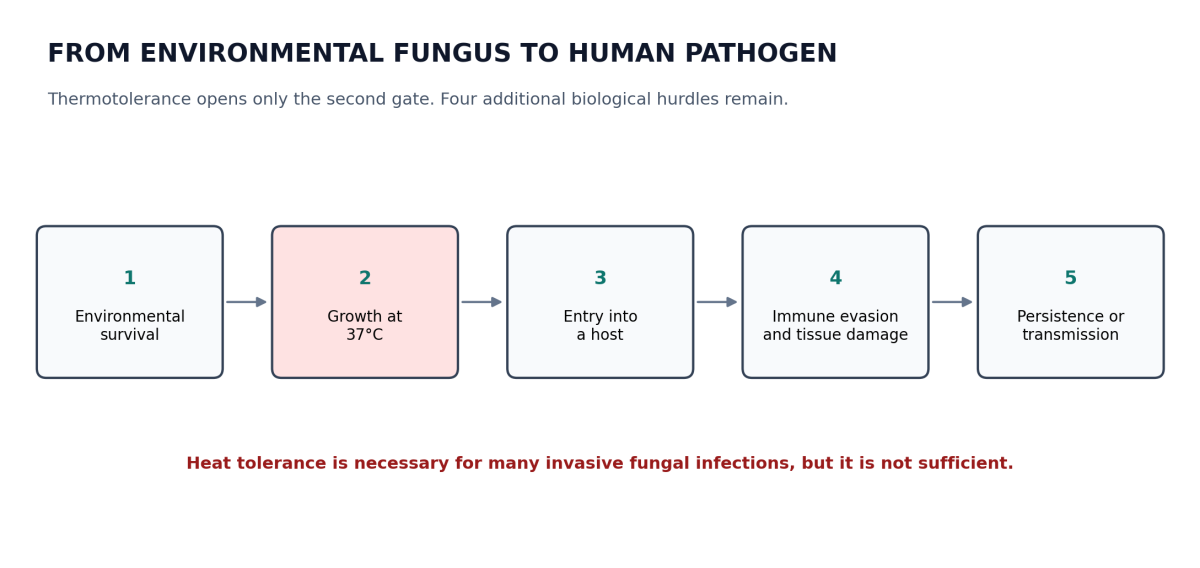
Most environmental fungi cannot grow efficiently at the internal temperature of a healthy mammal. Before a fungus can obtain nutrients from a host, evade immune cells or damage tissue, it must survive at approximately 37°C.
Analyses of fungal thermal tolerance suggest a steep filtering effect: above 30°C, each additional degree excludes roughly 6% of species from the pool capable of growth. A mathematical model balancing the protective benefit of heat against its metabolic cost produced an optimum near 36.7°C - remarkably close to normal human core temperature.
Warm-bloodedness is expensive. Mammals must continually consume energy to maintain a stable internal temperature. That expenditure, however, creates a thermal exclusion zone against much of the fungal kingdom. The defence is so fundamental that it usually goes unnoticed. Our bodies are simply too hot for most fungi.
That protection is not absolute. Aspergillus fumigatus, Cryptococcus neoformans, Candida auris and other fungi can grow at mammalian temperatures and cause severe disease, particularly in people whose immunity is weakened by cancer treatment, transplantation, HIV, critical illness or immune-suppressing medicines.
ARTURO CASADEVALL | Johns Hopkins University microbiologist
“Human temperature and immunity can be thought of as two defensive pillars. Immunity attacks organisms that enter the body, while temperature excludes an enormous number of fungal species before infection can begin. Most environmental fungi simply cannot grow efficiently at 37 degrees Celsius.
At present, the evidence that this boundary is moving is suggestive rather than definitive. The strongest demonstration would be a longitudinal record from the same environmental fungal lineage showing a heritable rise in maximum growth temperature over time, linked genomically and experimentally to heat exposure. The argument would become much stronger if that adaptation also improved survival in a mammalian host. Until those links are established, thermotolerance should be treated as a measurable risk mechanism, not proof of an emerging disease.”
A pathogen with no settled origin story
No fungus has shaped the climate discussion more than Candida auris.
The yeast was formally described in 2009 after being recovered from a patient in Japan. Within several years, genetically distinct groups had been identified in different regions of the world. C. auris combines several unusual traits: it tolerates relatively high temperatures, persists on skin and hospital surfaces, spreads in healthcare facilities and frequently resists antifungal medicines.
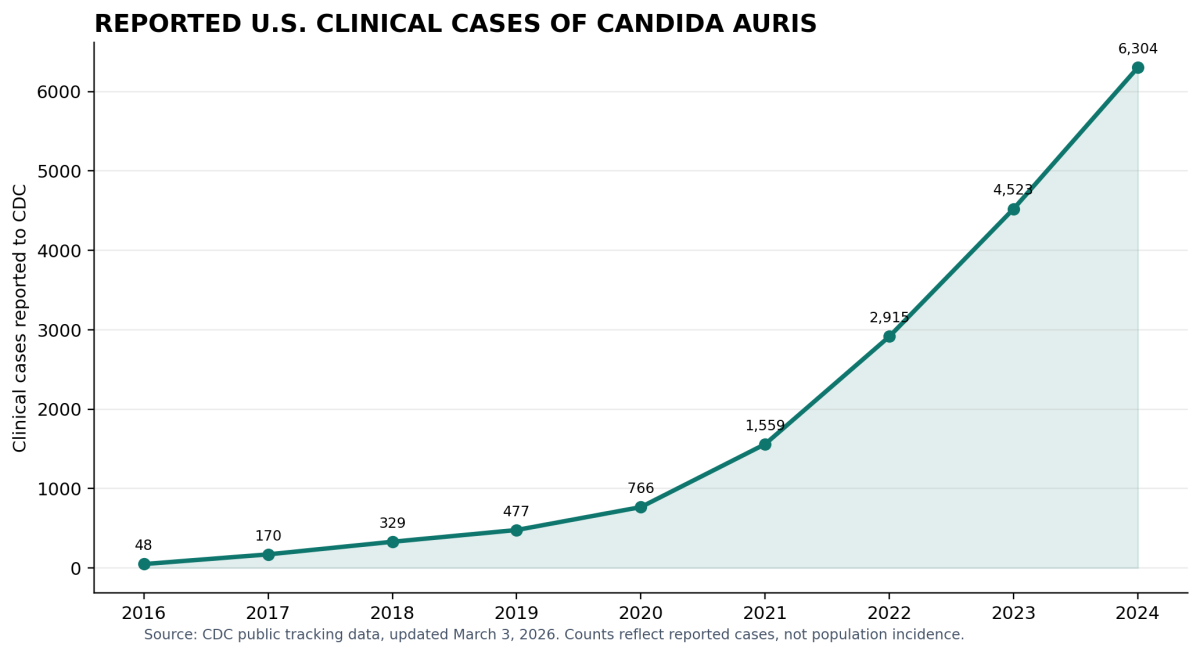
In the United States, CDC’s public tracking series rose from 48 reported clinical cases in 2016 to 6,304 in 2024 - more than a 130-fold increase in reported counts. From 2022 to 2024, the total more than doubled, although annual growth slowed from about 55% in 2023 to 39% in 2024. CDC cautions that testing and reporting practices influence the series and that these figures are reported clinical cases, not population incidence.
The numbers establish C. auris as a healthcare threat. They do not establish why it emerged.
In 2019, Arturo Casadevall and colleagues proposed that ancestors of C. auris may have adapted to warmer environmental conditions and thereby acquired greater ability to tolerate mammalian temperature. The recognition of distinct genetic clades in different regions made the idea compelling: similar environmental pressures might have produced parallel transitions.
MATTHEW FISHER | Professor of Fungal Disease Epidemiology, Imperial College London
“The strongest objection is that we do not possess the historical chain of evidence required to demonstrate causation. We have not identified a well-sampled ancestral population of Candida auris and watched it acquire thermotolerance as environmental temperatures increased. The organism may already have possessed substantial heat tolerance before its recognition in patients.
These explanations are not mutually exclusive. Environmental change may have contributed to initial adaptation, antifungal exposure may have shaped resistance, and healthcare networks may have amplified transmission. The missing evidence is a time-resolved ecological and genomic record connecting environmental temperature, heritable adaptation and the transition into human infection.”
Uncertainty is not a weakness in this story. It is the centre of it.
When body heat becomes an accelerator
A second line of evidence comes from a reddish yeast with a formidable name: Rhodosporidiobolus fluvialis.
Through China’s national hospital surveillance network, researchers identified two independent human infections involving the species. The known clinical sample is far too small to establish a broad public-health threat, and the study did not show sustained human-to-human transmission. Its laboratory findings, however, changed the scientific question.
JINGJING HUANG | Co-first author of the R. fluvialis study
“At mammalian body temperature, the fungus experienced greater mutational activity than under the cooler comparison condition. Heat stress increased intracellular reactive oxygen species, which contributed to genomic damage and mutagenesis.
Some mutants shifted towards pseudohyphal growth, and this form showed greater virulence in the mouse model. Under antifungal pressure, temperature-induced variation also generated strains resistant to fluconazole, caspofungin and amphotericin B. The significance is that body temperature did not act only as a barrier; in a fungus able to survive it, the temperature could also create conditions that accelerated adaptation.
This does not mean that the two recognised human cases predict a wider outbreak, or that every infection will generate pan-resistant variants. The clinical sample is extremely limited, and laboratory selection cannot reproduce the full complexity of a human infection. We also need to establish how widespread this temperature-dependent mechanism is across fungal species.”
The result exposes a paradox. For most fungi, 37°C is a wall. For a rare organism already capable of surviving near the threshold, the same temperature can become a severe stress that accelerates genetic change. Most cells may fail. Rare variants persist. Natural selection then acts on the survivors.
A host could therefore become more than a habitat. In particular species and under particular conditions, it could become a high-temperature evolutionary environment in which drug resistance and virulence emerge.
The experiment changes what surveillance should look for. A fungus need not arrive inside a patient fully adapted to every drug and host defence. It may cross the temperature barrier with an incomplete toolkit and evolve further after entry.
The diagnostic blind spot
For a critically ill patient, fungal emergence does not begin as an evolutionary argument. It begins as fever, falling blood pressure, respiratory failure or sepsis that looks bacterial until treatment fails - and as a race between a deteriorating patient and a reliable laboratory answer.
Fungal diagnosis can be slow and uneven. Traditional biochemical systems can misidentify C. auris as other yeasts; accurate identification may require updated mass-spectrometry libraries or sequencing. A delay changes more than the patient’s treatment. Because C. auris can persist on skin and surfaces and move between vulnerable patients, delayed identification can also become delayed infection control.
The treatment cabinet is unusually thin. CDC recommends an echinocandin as initial therapy for most adult clinical infections, but reports of echinocandin-resistant and pan-resistant strains are increasing. Some isolates resist all three major antifungal classes, leaving clinicians to consider more toxic alternatives or investigational medicines on limited evidence.
The immediate clinical threat is therefore not a hypothetical future fungus. It is a patient whose infection is identified late, after standard antibiotics have failed and before susceptibility testing can show which of a small number of antifungal options might still work.
In 2025, the World Health Organization published its first dedicated global analyses of fungal diagnostics and the antifungal development pipeline. WHO found that only four new antifungal drugs had been approved by stringent authorities in the United States, European Union or China during the previous decade. Nine medicines targeting priority fungi were in clinical development, only three of them in phase 3. Many available diagnostic tests require equipped laboratories and trained staff that remain inaccessible in much of the world.
Fungal drug development is difficult because fungal cells are biologically closer to human cells than bacteria are. A molecule that harms the fungus may also harm the patient. Existing therapies can involve toxicity, drug interactions, limited formulations and prolonged hospital care.
This is why a rare thermotolerant fungus matters before it produces a large case count. Waiting for perfect epidemiological certainty may mean noticing an organism only after it is established. Yet treating every heat-tolerant yeast as a future killer would create fear without preparedness. The challenge is to identify which organisms merely tolerate 37°C and which also possess the additional traits needed for disease.
Building a fungal early-warning system
The most useful outcome of the Baltimore research may be neither a warning nor a prediction. It may be a protocol.
Cities could sample fungi from hot and cool microenvironments using standardised methods. Sidewalks, soil, drainage systems, public transport, hospital surroundings and air-conditioning equipment could be monitored across seasons and years. Isolates could be tested at several temperatures, sequenced and assessed for drug susceptibility.
Clinical laboratories could preserve and sequence unusual isolates rather than dismissing them as contamination. Environmental collections could then be compared with organisms appearing in hospitals.
Several findings would make the warming hypothesis substantially stronger: a heritable rise in the maximum growth temperature of the same lineage over time; genomic changes experimentally linked to heat exposure; closely related strains recovered from both hot environments and human infections; and evidence that thermal adaptation also improves survival inside mammalian hosts.
Negative findings would matter just as much. If hot and cool cities show no repeatable difference, if thermotolerant isolates cannot invade hosts or if clinical strains are unrelated to environmental populations, the hypothesis would need to be narrowed or rejected.
That is the distinction between surveillance and prophecy.
What warming can—and cannot—do
The language of microbial adaptation invites exaggeration. Fungi do not consciously learn to infect humans. Heat does not direct them towards a predetermined goal, and climate change does not guarantee the emergence of any particular pathogen.
Natural selection changes probabilities. Within a large population, cells and strains vary. When temperatures rise, less tolerant variants may grow slowly or die, while more tolerant variants leave more descendants. Over generations, the composition of the population can change.
Urban heat islands may intensify this filtering in specific habitats. Global warming may extend the duration or geographic reach of conditions favouring thermotolerant organisms. Extreme heat events may impose abrupt selection. None of these processes guarantees infection.
Temperature is one lock among many. A fungus able to grow at 37°C may still be unable to attach to human tissue, acquire nutrients, evade immune cells, damage organs or find a route of transmission. It may remain an ecological curiosity.
Climate is also only one force shaping fungal disease. More people now survive transplantation, cancer therapy and critical illness while taking medicines that suppress immunity. Invasive devices and long hospital stays create routes into the body. Agricultural fungicides and medical antifungals apply chemical selection. Travel, floods, drought, construction and land-use change alter exposure. Healthcare networks can amplify organisms adapted to vulnerable hosts.
A credible account must hold these explanations simultaneously.
The available evidence does not prove that warming will produce a wave of new fungal pathogens. It does show that one of humanity’s oldest protections against fungi depends on a temperature difference—and that the fungal side of that difference is biologically capable of changing.
Watching the line
At 37°C, the human body possesses a defence that predates medicine.
It excludes most of an entire biological kingdom. It operates every hour of every day, asking nothing of its host except the energy required to remain warm.
The Baltimore study does not show that the defence is collapsing. A yeast recovered with candy from a hot pavement is not evidence of an approaching pandemic. The laboratory work on R. fluvialis does not establish that the organism will become a major human pathogen. The origin of C. auris remains unresolved.
But these findings make the boundary measurable.
Scientists can compare fungi from warmer and cooler environments. They can test whether heat tolerance is inherited, whether mammalian temperature changes mutation rates and whether environmental organisms are related to strains appearing in hospitals.
For millions of years, mammals have lived on the protected side of a thermal divide.
On one side lies the vast environmental fungal world. On the other are warm bodies, vulnerable patients and a limited cabinet of medicines.
The question is not whether fungi will suddenly conquer that divide.
It is whether, one street, one strain and one degree at a time, the line has begun to move.


















What is your opinion on this topic?
Leave the first comment