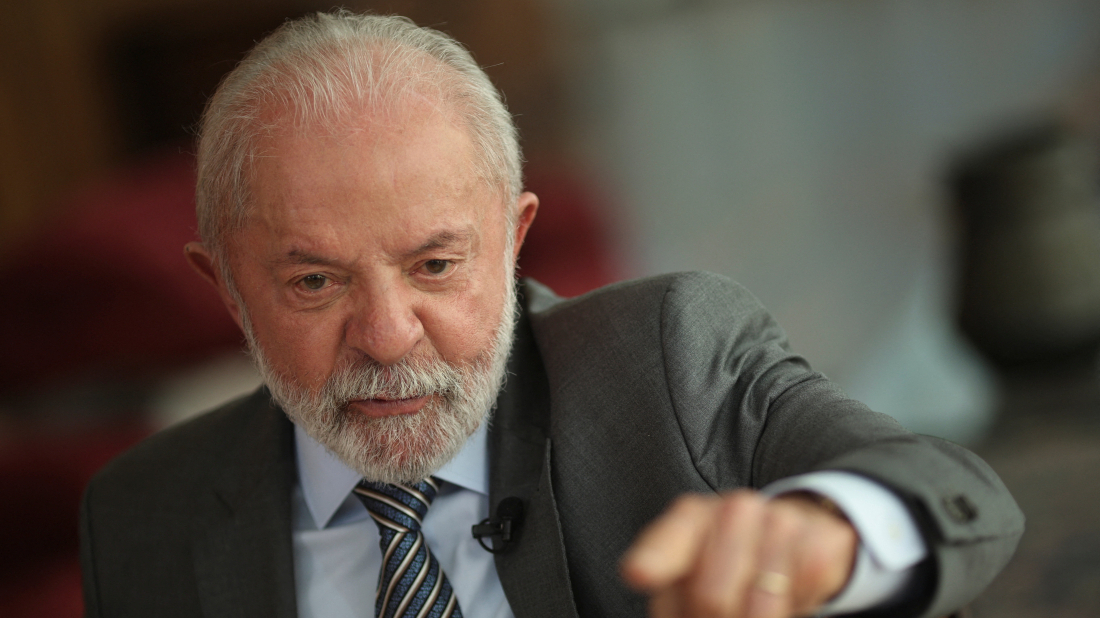
As U.S. tariffs on Brazilian goods jumped to 50% on Wednesday, Brazil's President Luiz Inacio Lula da Silva told Reuters that he saw no room for direct talks now with U.S. President Donald Trump that would likely be a "humiliation."
Brazil is not about to announce reciprocal tariffs, he said. Nor will his government give up on cabinet-level talks. But Lula himself is in no rush to ring the White House.
"The day my intuition says Trump is ready to talk, I won't hesitate to call him," Lula said in an interview from his presidential residence in Brasilia.
"But today my intuition says he doesn't want to talk. And I won't humiliate myself."
In interviews with Reuters, Lula outlined plans to engage fellow BRICS leaders—including India’s Narendra Modi and China’s Xi Jinping—to coordinate a unified response to the escalating U.S. trade measures.
Lula criticised Trump’s approach as an attempt to dismantle the established multilateral system of collective agreements, replacing it with unilateral, one-on-one negotiations that disadvantage smaller countries.
“What bargaining power does a small Latin American country have against the United States? None,” he remarked.
Under Lula’s leadership as the current BRICS chair, Brazil aims to convene discussions among member states—including Russia and South Africa—to assess the implications of U.S. tariffs and formulate a collective strategy.
Highlighting the group’s significance, he noted that BRICS countries account for ten members of the G20, the forum of the world’s largest economies.
The tariffs have already impacted BRICS members significantly. Last month, the U.S. imposed a 50% tariff on many Brazilian exports amid political disputes linked to former Brazilian President Jair Bolsonaro. Trump has also threatened additional tariffs on Indian imports due to the country’s reliance on Russian oil, alongside existing steep tariffs on Chinese and South African goods.
National Council for New Mineral Materials
Separately, Lula has announced a new national policy to treat strategic minerals as a matter of “national sovereignty,” signalling Brazil’s intent to shift away from exporting raw minerals towards adding value domestically. He unveiled plans to establish a National Council for New Mineral Materials, which will oversee resources such as rare earths and report directly to the presidency. This move aims to prevent Brazil from falling into a resource vacuum while other nations benefit from mineral wealth, and to encourage investment by streamlining engagement with businesses.
Acknowledging Brazil’s technological challenges, Lula stressed the importance of international partnerships with countries such as the U.S., China, and Germany to bolster the nation’s role in the global energy transition. The new policy also includes comprehensive mapping of Brazil’s mineral resources, laying the groundwork for the country to become a global leader in sustainable energy development.
Lula’s dual approach—defending multilateralism on the international stage while advancing strategic economic sovereignty at home—reflects Brazil’s ambition to assert greater influence amid shifting geopolitical and economic landscapes.












What is your opinion on this topic?
Leave the first comment