The AnewZ Opinion section provides a platform for independent voices to share expert perspectives on global and regional issues. The views expressed are solely those of the authors and do not represent the official position of AnewZ
Marine Le Pen benefits from a fragmented opposition. The consequences could reach beyond the presidency, into Ukraine, NATO and the commitments that hold European security together.
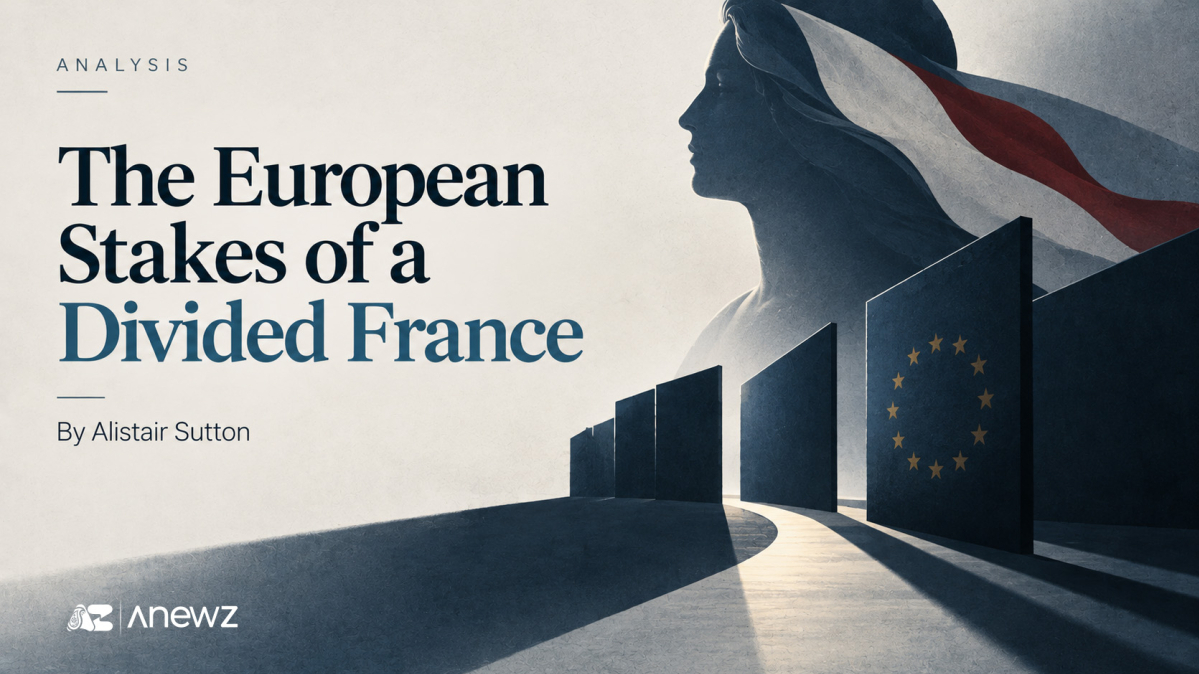
Europe’s security could turn on a French contest for second place. Marine Le Pen’s lead ahead of the 2027 presidential election makes the identity of her challenger unusually consequential. It also exposes a deeper problem: the parties that want France to sustain its European commitments have yet to show that they can assemble a durable majority at home.
The latest Toluna Harris Interactive survey for M6 and RTL, conducted on 5–8 October, puts Le Pen at 35–37 per cent across five first-round scenarios. Jean-Luc Mélenchon places second in each, although his advantage over Édouard Philippe narrows to a single point in some configurations. These are snapshots of voting intentions, with uncertainty large enough to matter in the race behind Le Pen. They are not probabilities of victory.
France’s two-round system gives that distinction practical force. Unless someone wins an outright majority in the first round, only the leading two candidates advance. A divided field can therefore turn a relatively modest share of the vote into a place in the final contest. Voters who reject the frontrunner may discover that their preferred alternative has already been eliminated.
Le Pen benefits twice. She has a substantial base of her own, while her rivals compete to decide who will challenge her. The mistake would be to describe everyone outside the National Rally, or RN, as a single opposition waiting to unite. They disagree over pensions, taxation, public spending and France’s place in the world. Their divisions have political substance.
A fragmented opposition
That is why the familiar picture of three blocs is incomplete. Alongside the far right, Mélenchon’s radical left and the competing heirs to Emmanuel Macron sits a centre-left project with its own ambitions. Raphaël Glucksmann’s victory in the social-democratic primary on 11 October gives that project a candidate. It does not give him command of the entire left. Crucially, the latest Harris survey predates his victory and cannot measure any resulting lift in support.
Philippe faces the most immediate arithmetic. In the Harris scenario containing both him and Gabriel Attal, he polls 13 per cent and Attal five. Without Attal, Philippe reaches 17 per cent, still just behind Mélenchon. The centre’s problem therefore extends beyond having too many candidates. Removing a rival does not guarantee that every voter follows, or that the remaining candidate acquires a persuasive reason to govern.
For Philippe, the challenge is to explain what would change after Macron. For Glucksmann, it is to connect a pro-European outlook with a credible domestic programme. Mélenchon must show that his capacity to mobilise committed supporters can extend to voters who distrust his politics. Each faces the same institutional test: qualifying for the runoff and winning it require different coalitions.
Le Pen has vulnerabilities too. July’s appeal ruling reopened her path to the presidency by reducing her election ban, while upholding her conviction for misusing European Union funds. Separately, Mediapart’s allegations about antisemitic messages attributed to Jordan Bardella, which he denies, test the RN’s effort to present itself as fit for office. A strong polling position cannot establish that either issue will be electorally harmless.
For Europe, however, the most consequential question is what the candidates would do with power. Ukraine makes their differences concrete. Decisions about aid, military cooperation and alliance obligations would reach well beyond the French electorate. Other governments would have to plan around them.
Ukraine and NATO at stake
Le Pen and Bardella’s statement of 19 September condemned Russian intimidation and rejected attempts by Moscow to dictate French policy. It would be inaccurate to ignore that language. Yet Le Pen has also argued that France should stop financial aid to Ukraine while remaining willing to provide military equipment and training. Condemning Russian pressure leaves open the question of how much France would spend to resist it.
Her NATO position also requires precision. She wants France to leave the alliance’s integrated military command, while retaining NATO membership; in September, she said she would defer that move while the war in Ukraine continued. Those qualifications matter to any assessment of the policy. They also leave allies facing a future decision whose timing would depend on how a French president judged the war and its aftermath.
Mélenchon proposes a more extensive institutional departure. His June argument for cooperative non-alignment included leaving NATO and strengthening cooperation with China. He has called for Russian forces to withdraw from Ukraine, while favouring diplomacy and restrictions on long-range strikes. His position should be assessed on those terms, including the unresolved question of what security arrangements would replace the alliance commitments he rejects.
Philippe offers a different answer. During his May visit to Kyiv, he backed Ukraine’s NATO integration and the deployment of European troops after the war to deter another Russian attack. Glucksmann’s pro-European, pro-Ukraine politics similarly place collective security near the centre of his candidacy. Both would need to persuade French voters that sustained commitments abroad serve interests they can recognise at home.
These positions reveal the European risk in a Le Pen–Mélenchon runoff. The candidates have sharply different domestic programmes and distinct foreign-policy proposals. But the final choice could still exclude the principal advocates of deeper European and Atlantic security cooperation. Agreement among those advocates on Ukraine would have failed to produce enough agreement to keep either of them on the ballot.
The challenge for Europe
Such an outcome remains contingent. Candidates can withdraw, campaigns can change and voters can revise their choices. Nor would a French election erase the institutions, interests and alliances that constrain a president. But European partners cannot assume that continuity will survive simply because reversing it would be difficult. Smaller contributions and repeated disputes over commitments could weaken common action without a formal French exit from any institution.
The domestic argument will be decisive. Le Pen’s claim that France cannot afford further financial support for Ukraine invites voters to compare foreign commitments with unmet needs at home. Her opponents need to explain the costs of their own proposals, including who pays for them. They also need to make the case that weakening Ukraine could create larger security costs later. Treating questions about affordability as illegitimate would surrender the argument before answering it.
The burden runs both ways. Anyone proposing to reduce those commitments should explain the savings, the risks and the replacement strategy. Training Ukrainian soldiers requires resources. So does deterring a future attack. A promise of national independence becomes useful only when it explains how France would obtain the capabilities and cooperation needed to exercise it.
Europe’s other governments should draw a practical conclusion. They need to make joint commitments easier to sustain through changes of government, with transparent costs, credible delivery and benefits that voters can see. They should also prepare for a French administration that bargains harder over contributions. Building policy around the expectation that a preferred candidate will win is an avoidable strategic weakness.
There is a final constraint beyond the presidential contest. Winning the Élysée does not automatically deliver control of parliament. France’s executive powers are shared, and an opposing parliamentary majority can produce cohabitation. The capacity to fund and implement a programme will depend on the political support available after the presidential vote as well as the authority conferred by it.
For now, Le Pen has the clearest electoral advantage. Her opponents’ task is to turn separate constituencies into support for a credible government. Europe has a direct interest in whether they can do so, but no vote in the outcome. French voters will choose a president. Their neighbours will have to decide what they can still build with France.

















What is your opinion on this topic?
Leave the first comment