The AnewZ Opinion section provides a platform for independent voices to share expert perspectives on global and regional issues. The views expressed are solely those of the authors and do not represent the official position of AnewZ
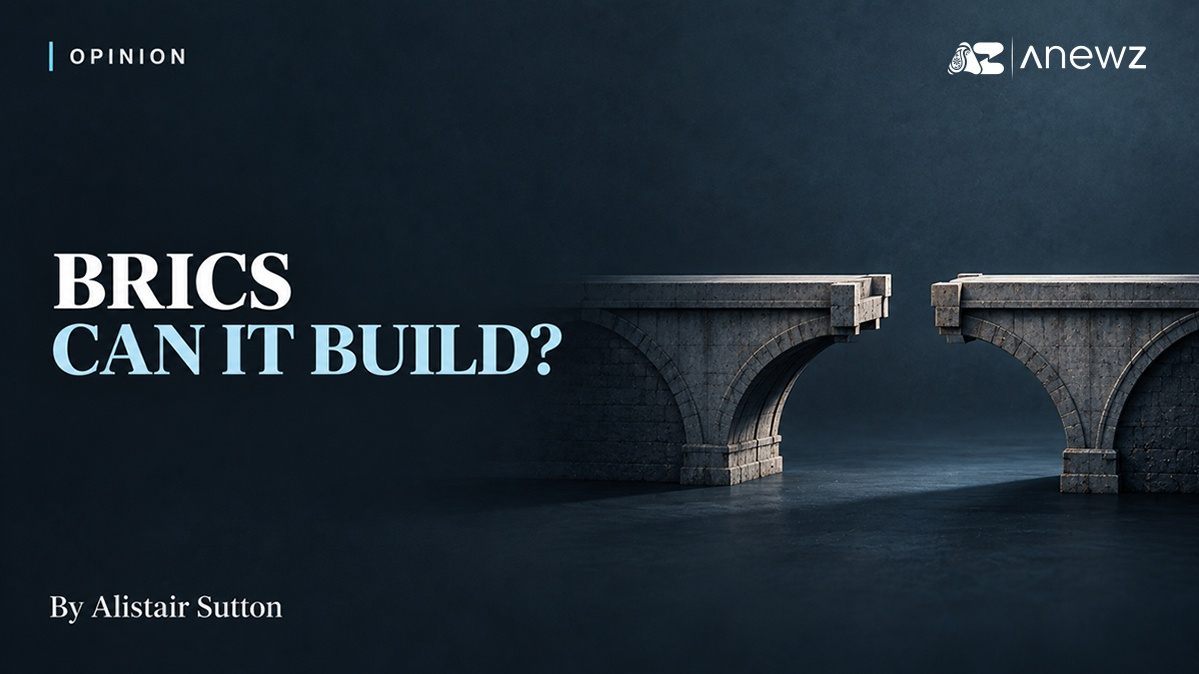
BRICS has a scale problem. Not because it is too small, but because its political ambitions are growing faster than its ability to turn them into common action.
The 18th BRICS Summit, held in New Delhi on 12–13 September, demonstrated just how far the grouping has travelled. Eleven member states gathered under India’s presidency to discuss energy and food security, trade, investment, technology, financial cooperation and the reform of global governance.
The summit concluded with the adoption of the New Delhi Declaration, setting out shared priorities across political, economic and institutional issues.
On paper, this is the language of an increasingly consequential international grouping.
But scale is not the same as cohesion.
BRICS now brings together states with enormous populations, resources, markets and geopolitical weight. It also unitesgovernments with different strategic interests, varying relationships with the U.S. and Europe, unresolved bilateral disputes and very different ideas about what BRICS itself should become.
That contradiction may define the organisation’s next phase.
The question is no longer whether BRICS matters. It does.
The harder question is whether it can convert that importance into institutions capable of delivering what its members increasingly demand of it.
From rule-takers to rule-shapers
India used the New Delhi summit to frame BRICS as a stronger voice for the Global South.
Prime Minister Narendra Modi argued that developing countries should move from being rule-takers to becoming rule-shapers in global governance. The New Delhi Declaration similarly called for reform of international institutions, including the United Nations and its Security Council, and greater representation for emerging and developing economies.
This is not a new BRICS argument.
What has changed is the weight behind it.
The grouping’s expansion of the grouping has increased its demographic, economic and political reach. Countries as different as China, India, Russia, Brazil, Iran, the United Arab Emirates, Saudi Arabia, Egypt, Ethiopia, Indonesia and South Africa now sit within the same framework.
That gives BRICS greater visibility.
It also makes consensus more difficult.
The organisation is sometimes described as an emerging counterweight to the West. But that description can obscure more than it explains. India, the UAE and several other members maintain extensive economic and strategic relationships with Western countries. China and Russia have their own visions of the international order. Iran has a fundamentally different relationship with Washington from many other BRICS members.
BRICS therefore works precisely because it does not require its members to share a single geopolitical identity.
But the same flexibility that makes expansion possible also limits integration.
A diplomatic room for countries that disagree
The New Delhi summit showed one area where BRICS already has considerable value: diplomacy.
The meeting between Modi and Chinese President Xi Jinping was significant in itself. Their countries remain strategic competitors and continue to manage a difficult border relationship. Yet the two leaders used the summit to emphasise stabilisation, dialogue and the principle that differences should not automatically become disputes.
BRICS provides a room in which such conversations can take place.
That may sound modest compared with the language of a new global order, but it should not be underestimated.
An international institution does not have to eliminate geopolitical rivalry to be useful. Sometimes its value lies in ensuring that rivals continue talking.
That becomes increasingly important as BRICS grows. Its members include states that disagree over regional security, trade, sanctions, relations with Washington and the architecture of the international financial system.
The organisation’s diversity is therefore both its weakness and one of its principal assets.
It is a platform where agreement is difficult precisely because the countries around the table are not natural allies.
The economic ambition outpaces the machinery
The deeper test, however, lies in economics.
BRICS members have repeatedly discussed expanding trade in national currencies, strengthening alternative payment mechanisms and reducing vulnerabilities created by dependence on financial infrastructure dominated by Western institutions.
The attraction is understandable.
Sanctions, secondary sanctions, tariffs and geopolitical fragmentation have made financial infrastructure a strategic issue. Payment systems are no longer simply technical mechanisms for moving money between banks. They are increasingly part of national economic security.
Several BRICS countries already possess sophisticated domestic instant-payment systems. India’s UPI and Brazil’s Pix demonstrate how quickly national payment infrastructure can transform financial transactions.
Connecting such systems across borders could eventually reduce transaction costs and allow more trade to be settled directly in national currencies.
But there is a considerable gap between discussing interoperability and constructing a functioning BRICS-wide payments architecture.
Who sets the technical standards?
How are currencies cleared?
Which institutions manage liquidity?
How are disputes resolved?
What happens when participating countries are subject to different sanctions regimes?
And, perhaps most importantly, how much sovereignty are governments prepared to surrender to make a common system work?
These are not minor details.
They are the foundations of such a system.
Until those questions are answered, the idea of a BRICS payments architecture remains strategically important but institutionally incomplete.
De-dollarisation is not a switch
This is also why discussions about BRICS and “de-dollarisation” require caution.
The dollar’s international position is not based simply on political preference. It rests on deep capital markets, liquidity, financial infrastructure, institutional familiarity and the enormous network effects created by decades of international use.
Countries can increase settlement in national currencies without replacing the dollar as the central currency of the global financial system.
These are two very different processes.
BRICS may therefore contribute to a more diversified international monetary environment without producing a dramatic rupture with the existing system.
That distinction matters.
The most realistic transformation may not be the emergence of one alternative financial order replacing another. It may be the gradual construction of parallel mechanisms that give states more options.
In geopolitical terms, having those options can itself provide leverage.
Expansion creates influence - and friction
The fundamental BRICS paradox becomes clearer as the organisation grows.
Every new member increases its global reach.
Every new member can also make common policy harder.
China and India alone illustrate the problem. Both want greater influence for emerging economies in international institutions, yet they remain strategic competitors with unresolved disagreements.
Russia and Iran see sanctions as central strategic vulnerabilities. Other BRICS members may oppose unilateral economic pressure while remaining deeply integrated with American and European financial markets.
Energy exporters and importers do not always share the same interests.
Neither do large manufacturing economies and commodity-dependent states.
BRICS can issue consensus declarations across these divides. Translating them into binding or coordinated policies is considerably harder.
This is not necessarily evidence of failure.
The European Union required decades to build its present institutional architecture, and its members remain divided on major issues despite far deeper integration.
BRICS is not attempting to become another EU.
But the comparison illustrates a basic principle: political ambition requires institutional machinery.
Declarations can establish direction.
Institutions determine whether anyone actually moves.
India targets the implementation gap
One of the more revealing developments in New Delhi was India’s emphasis on continuity and implementation.
The summit backed further work on institutional development, including an online archival database and mechanisms intended to improve the tracking of BRICS commitments across successive presidencies.
This sounds bureaucratic. But it could prove strategically important.
BRICS operates through rotating presidencies. Each chair brings its own priorities, initiatives and diplomatic emphasis. Without strong continuity mechanisms, projects can accumulate faster than they are implemented.
The danger is obvious.
A grouping can produce an impressive number of summits, declarations, working groups and initiatives while gradually creating a widening gap between what has been announced and what has actually been built.
Institutional memory therefore matters.
So does accountability.
If BRICS wants greater influence over global governance, it will increasingly be judged not by the number of initiatives it announces but by how many survive the summit at which they were launched.
The real test comes after New Delhi
The 18th BRICS Summit demonstrated that the grouping has entered a different phase.
Its relevance is increasingly difficult to dismiss.
Its members include major energy producers and consumers, enormous populations, important trading economies and some of the most influential states outside the traditional Western institutional core.
They also share concerns about representation in global governance, the use of sanctions, financial vulnerability and the distribution of power inside institutions created for a very different international system.
But dissatisfaction with the existing order does not automatically produce agreement on its replacement.
That is the central BRICS challenge.
Its members may agree that the international system should become more representative without agreeing on precisely what should replace existing arrangements.
They may support greater use of national currencies without agreeing on a common financial architecture.
They may want deeper economic cooperation while simultaneously competing with one another.
And they may value BRICS precisely because it allows all of these contradictions to coexist.
The New Delhi summit therefore should not be judged by whether BRICS emerged as a unified geopolitical bloc.
It did not need to.
The more important test is whether a diverse group of states can build practical cooperation without first requiring political uniformity.
That would be a more modest achievement than constructing a new world order.
It might also be a more consequential one.
BRICS has already demonstrated that it can expand.
It has demonstrated that it can convene.
And it has demonstrated that it can articulate dissatisfaction with parts of the existing international system.
Now comes the harder stage.
Can it build?
Because in the next phase of BRICS, influence will not be measured by how many leaders sit around the table.
It will be measured by what still exists after they leave it.
Read more AnewZ opinion Pieces :














What is your opinion on this topic?
Leave the first comment