Azerbaijan reopens embassy in Tehran, highlighting 'special relationship'
The reopening of Azerbaijan’s embassy in Iran reflects the “special relationship” between the two countries, a regional expert has said.
The Iranian President, Masoud Pezeshkian, said that the U.S. hegemonic approach has been the main obstacle to reaching a fair agreement, his office announced on Monday.
Oil tankers are steering clear of the Strait of Hormuz ahead of a U.S. blockade later on Monday following failed peace talks between the U.S. and Iran over the weekend, shipping data showed.
Amid fragile calm, António Guterres urged constructive U.S.- Iran talks, while Pope Leo XIV warned violence is spreading. Lebanon's President said an Israeli strike killed 13 security personnel in Nabatieh.
Iran’s Supreme Leader Ayatollah Seyed Mojtaba Khamenei has declared a “decisive victory” over the U.S. and Israel, signalling a “new phase” in Tehran’s control of the strategic Strait of Hormuz.
Caricatures of U.S. President Donald Trump and Israeli Prime Minister Benjamin Netanyahu are on display in a metro station in downtown Tehran. The cartoons mock the two leaders for what Tehran says is their failure in waging a war on Iran.
Israeli Prime Minister Benjamin Netanyahu says he has given an instruction for Israel to begin peace talks with Lebanon that would also include the disarming of Hezbollah.
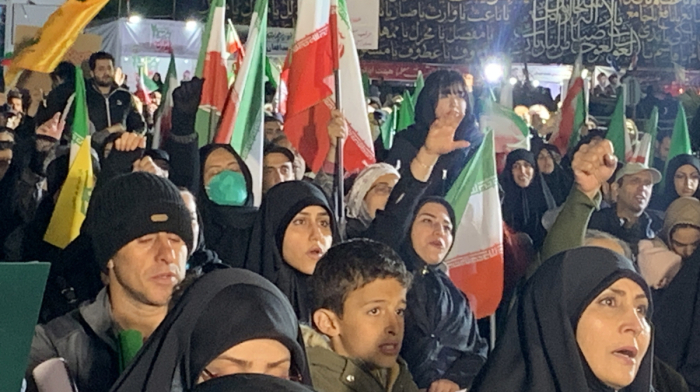
Memorial events were held in Tehran’s main squares on Wednesday (8 April) to mark the 40th day since the killing of former Supreme Leader Ayatollah Ali Khamenei, who died during U.S.-Israeli attacks on 28 February.
Iranian officials have criticised ceasefire violations by Isreal and U.S., citing Israeli airstrikes on Lebanon on Wednesday (8 April), an intrusion of a military drone, and a U.S. denial of Tehran’s right of nuclear enrichment, on the first day of the two-week ceasefire on Wednesday.
UK's Prime Minister Sir Keir Starmer has welcomed a ceasefire between Iran and the United States, that was reached overnight, as he travels to the Gulf to support diplomatic efforts to sustain the agreement and stabilise the region.
Iran’s Supreme National Security Council (SNSC) announced on Wednesday that ceasefire negotiations with the U.S. are scheduled for Friday (10 April) in Islamabad, stressing that it will enter into two weeks of talks “out of total distrust”.
President Donald Trump warned Iran he would target power plants and bridges unless it reopened the Strait of Hormuz by Tuesday night - but what actually happened?
U.S. President Donald Trump threatened Iran's "whole civilisation" on Tuesday in a post on social media. Meanwhile, the UN failed to reach an agreemement on a resolution aimed at reopening the Strait of Hormuz, after China and Russia used their vetoes.
President Donald Trump threatened to rain "hell" on Tehran if it did not make a deal and reopen the Strait of Hormuz by his Tuesday deadline, as he praised U.S. special forces who rescued an airman in a high-risk mission from deep inside Iran.
U.S. President Donald Trump threatened Iran's energy and transport infrastructure in a social media post containing expletives on Sunday (5 April), as he seperately gave Iran a deadline of Tuesday to reopen the Strait of Hormuz.
President Donald Trump said the U.S. "hasn't even started destroying what's left in Iran", reiterating vows to increase the ferocity of attacks on its infrastructure, as dozens of countries sought ways to restart vital energy shipments through the Strait of Hormuz
Iranian President Masoud Pezeshkian urged Americans to look beyond the illusions of war propaganda and to watch out for Israel’s "manufactured threat," in an open letter to the United States.
President Donald Trump said the United States could end its military attacks on Iran within two to three weeks and Tehran did not have to make a deal as a prerequisite for the conflict to wind down.
Iran on Monday described U.S. proposals to end a month-long war in the Middle East as “unrealistic, illogical and excessive” and launched further missile strikes on Israel as oil prices continued to climb following Yemen’s Houthi entry into the conflict.
The Israeli military said on Monday that Iran launched multiple waves of missiles at Israel, and an attack had also been launched from Yemen for the second time since the U.S.-Israeli war began on Tehran. It said two drones from Yemen were intercepted early 30 March but gave no further details.
The United Arab Emirates has told the U.S. and other Western allies that it is willing to participate in a multinational maritime taskforce aimed at reopening the Strait of Hormuz, the Financial Times reported on Friday, citing people familiar with the matter.
U.S. President Donald Trump said on Thursday he would pause attacks on Iran's energy plants for 10 days at Tehran's request and said talks with Iran were going "very well," although an Iranian official dismissed a U.S. proposal for ending nearly four weeks of fighting as "one-sided and unfair."
There’s little indication that recent developments between the United States and Iran have shifted either side’s core positions, according to political analyst James Dorsey who spoke to AnewZ on the Daybreak programme.
Iran is reviewing a U.S. proposal to end the war in the Gulf but has no intention of holding talks to wind down the widening Middle East conflict, the country's foreign minister said on Wednesday (25 March).
You can download the AnewZ application from Play Store and the App Store.