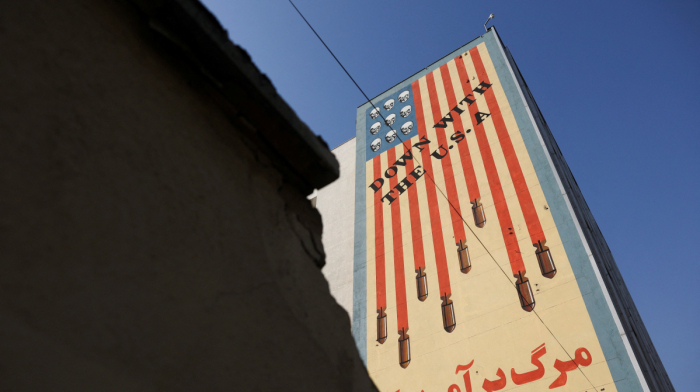
Iran cautiously welcomes 'encouraging signals' in nuclear talks with U.S.
Iranian President Masoud Pezeshkian has said nuclear talks with United States have “yielded encouraging signals” stressing Iran’s readiness “for any potential scenario”.
Iran has warned it will respond “decisively” if subjected to military aggression, saying U.S. President Donald Trump’s rhetoric signals “a real risk of military aggression”.
Iranian and Russian navies staged a joint exercise in the northern Indian Ocean on Thursday, as Washington builds up its military assets in the region, including deploying warships near Iran, despite renewed indirect nuclear negotiations with Tehran.
Iran’s Foreign Minister Abbas Araghchi has firmly ruled out any discussion of the country’s ballistic missile capabilities in the newly resumed, Oman-mediated negotiations with the United States, stating they are not and will never be on the agenda.
Iran’s top diplomat Abbas Araghchi said Tehran has resumed negotiations with Washington "with seriousness and open eyes," stressing that progress depends on genuine commitment from the U.S. Meanwhile, security chief Ali Larijani warned that Israel is seeking to derail the newly resumed talks.
Iran’s President Masoud Pezeshkian has welcomed a fresh round of nuclear talks with the United States, insisting Tehran will protect its right to enrichment under the Non-Proliferation Treaty (NPT).
After months of heightened tension following their war in June 2025 and weeks of escalating mutual threats, Iran and the United States resumed fragile nuclear diplomacy on Friday, as negotiators from both sides held critical mediated talks in Muscat, Oman.
Iran’s Islamic Revolutionary Guard Corps (IRGC) has deployed one of its largest ballistic missiles at a newly unveiled underground base on Wednesday (3 February), just two days ahead of mediated nuclear talks with the United States in Muscat, Oman.
Images from Iran's Paya (Tolu 3) Earth observation satellite have been officially displayed for the first time by the Ministry of Information and Communications Technology (ICT).
Iran’s Foreign Minister Abbas Araghchi denounced the European Union's designation of the Islamic Revolution Guards Corps (IRGC) as a terrorist organisation as “another major strategic mistake” and “PR stunt.”
"Negotiate a fair and equitable deal -- NO NUCLEAR WEAPONS," U.S. President Donald Trump posted on Truth Social, otherwise the next U.S. attack on Iran "will be far worse." Tehran responded with a threat to strike back against the United States.
Sanctions are a long-used tool designed as an alternative to military force and with the objective of changing governments’ behaviour, but they also end up hurting civilian citizens.
Iran’s Foreign Ministry has strongly rejected a U.S. magazine report on the death toll during January unrest. Nationwide protests erupted in response to soaring inflation and a national currency crisis.
The United Nations nuclear watchdog must clarify its stance on U.S. and Israeli attacks on Iran's nuclear sites last June that lasted 12 days, before inspectors are allowed to visit those facilities, Iranian media on Friday quoted the country's atomic chief as saying.
Iran’s Commander-in-Chief of Army, Major General Amir Hatami has warned against hostile rhetoric from U.S. and Israeli officials. “Iran considers the intensification of the enemies' rhetoric against the Iranian nation as a threat and will not leave its continuation unanswered,” Hatami said.
Iran has denounced the U.S. detention of Venezuelan President Nicolás Maduro, describing the operation as an ‘abduction’ and calling for his immediate release.
Iran’s Foreign Minister Abbas Araghchi has stressed the need to expand comprehensive relations between Tehran and Baku, describing his visit to Azerbaijan last December as “constructive”.
The Head of Iran’s Atomic Energy Organisation (AEOI) Mohammad Eslami unveiled that the country’s civilian nuclear program has been the target of industrial sabotage by the Israeli and the U.S. intelligent agencies for the last three decades.
Iranian President Masoud Pezeshkian warned that Tehran’s answer to any aggression will be decisive and “discouraging” and Foreign Minister Abbas Araghchi urged his counterparts to strongly denounce US President Donald Trump’s recent threat of military strike against Iran.
Iran has ruled out a proposal by Iraqi Prime Minister Mohammed Shia' al-Sudani to mediate between Iran and U.S. and host bilateral nuclear talks in Baghdad.
Iran has rolled out a test vending of imported premium at market price in Tehran to address the country's domestic petroleum consumption deficit.
The Iranian government has announced plans to build nuclear power plants using domestic industrial capacity in conjunction with Russia.
Afghanistan and Iran have signed an implementation plan to strengthen regulation of food, medicine, and health products based on a 2023 cooperation agreement.
Iran has ruled out the U.S.-EU demand for a halt in its civilian nuclear program as an “impossible” pre-condition to restart nuclear negotiations.
You can download the AnewZ application from Play Store and the App Store.